
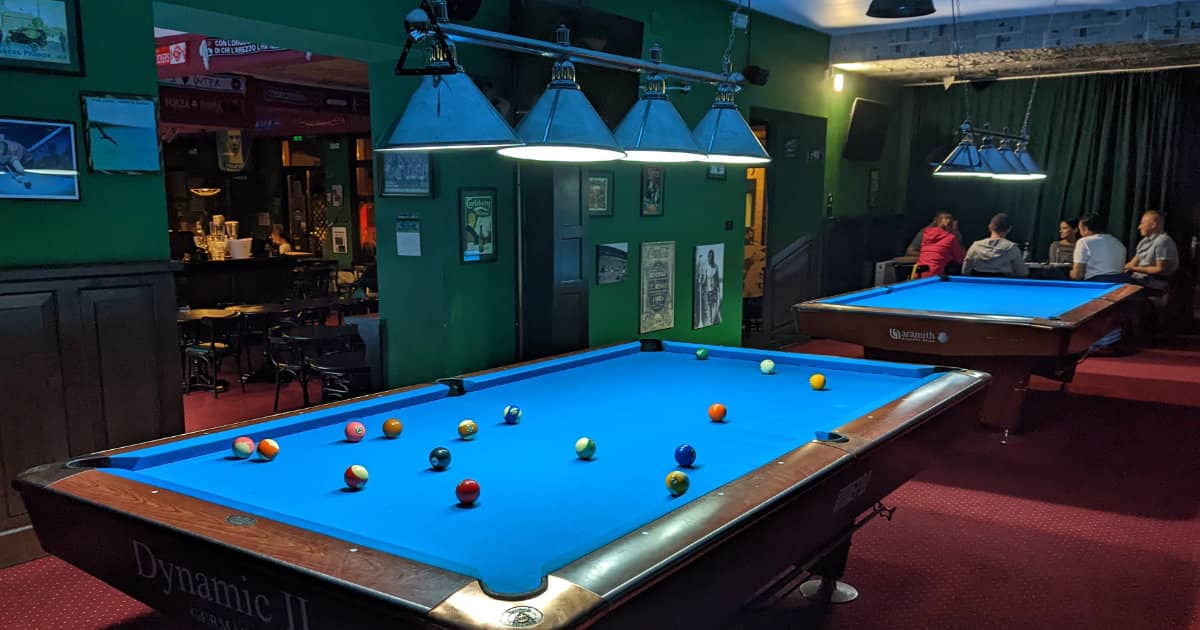
Why lighting matters
Ceiling spotlights and a single central lamp leave the corners and cushions dark and throw your head's shadow over the cue ball. A proper pool table light hangs low over the table, spreads light evenly from end to end and keeps the bulbs hidden from your eyes. You see the balls clearly, judge distances better and play more consistently.
Pool table light calculator
Choose your table and light style and enter your ceiling height. The calculator suggests a light length, how high to hang it and how bright it should be.
Assumes a table bed (playing surface) 76 cm (30 in) above the floor, the middle of the 74–79 cm (29¼–31 in) range in the WPA specification.
Rules of thumb, not an official standard. Check the maker's instructions and use a qualified electrician for hard-wired lights.
How high to hang a pool table light
Measure from the playing surface (the cloth), not the floor. Most makers recommend:
| Light type | Bottom of the light above the cloth | Above the floor (76 cm / 30 in table) |
|---|---|---|
| Pendant with shades | 81–91 cm (32–36 in) | about 1.57–1.67 m (62–66 in) |
| Flat LED panel | 100–140 cm (40–55 in) | about 1.76–2.16 m (70–85 in) |
| WPA tournament, light that can be moved aside | at least 1.02 m (40 in) | about 1.78 m (70 in) or more |
| WPA tournament, fixed light | at least 1.65 m (65 in) | about 2.41 m (95 in) or more |
Too low and you'll knock it with your head or cue on long-bridge shots; too high and light spills into the room while the corners of the table go dim. A shade light at about 85 cm (33 in) above the cloth suits most home players. Tall players often go a few centimetres higher.
The WPA figures come from its recommended equipment specifications for sanctioned events. They're higher than home recommendations because tournament lights are usually bright LED panels and players need full clearance.
What size light do you need?
A good rule of thumb: a shaded pendant should be about 55 to 70% of the length of the playing surface, and a flat LED panel a little longer. That keeps the ends of the table lit without the light hanging over the rails.
| Table | Playing surface | Pendant length | Shades |
|---|---|---|---|
| 6 ft English pool | 1.52 × 0.76 m | 84–106 cm (33–42 in) | 2 or 3 |
| 7 ft English pool | 1.83 × 0.91 m | 101–128 cm (40–50 in) | 3 |
| 7 ft American pool | 1.98 × 0.99 m | 109–139 cm (43–55 in) | 3 |
| 8 ft American pool | 2.24 × 1.12 m | 123–157 cm (48–62 in) | 3 or 4 |
| 9 ft American pool | 2.54 × 1.27 m | 140–178 cm (55–70 in) | 4 |
| 12 ft snooker | 3.57 × 1.78 m | 196–250 cm (77–98 in) | 5 or 6, or a canopy |
Snooker tables are usually lit by a long canopy, a box that hangs over most of the table with several lamps inside and a rim that hides the bulbs.
How bright should it be?
For tournaments, the WPA asks for at least 520 lux (48 foot-candles) at every point of the bed and rails, with the centre no brighter than the corners. It also says light aimed at players becomes blinding from about 5,000 lux, and the rest of the venue should get at least 50 lux.
Most homes don't need to hit tournament levels, but even, shadow-free light matters more than raw brightness. The calculator gives a rough lumen total for 520 lux on your table. With LED lights, check the lumen figure on the box.
- Use LEDs. They run cool (important when the light is close to your head), use little power and last for years.
- Choose diffused light. Frosted shades, diffuser panels or louvres spread the light and hide the bright points.
- Look for a high colour rendering (CRI 90 or more) so the ball colours look true.
Colour temperature
Warm white (2700–3000 K) feels cosy but can make yellow and orange balls hard to tell apart. Most players prefer neutral to cool white, around 4000–5000 K, which shows the cloth and balls clearly. Keep the rest of the room warmer and dimmer if you want atmosphere.
Light styles
- Three- or four-shade pendant: the classic look for home tables and bars. Choose shades that point the light down and hide the bulbs.
- Flat LED panel: a long, slim, rectangular light. The most even light and the best choice for low ceilings and serious practice. Many pool halls use them.
- Tiffany-style and decorative lights: beautiful, but coloured glass tints the light. Make sure the bottom is open or frosted.
- Snooker canopy: a box light covering most of a large table, standard in snooker clubs.
Pool halls usually go for LED panels over every table, often on a timer linked to the table booking. See our guide to pool hall POS and table software.
Low ceilings
With a ceiling under about 2.4 m (8 ft), a hanging pendant may end up too high above the table or too low for your head. A flat LED panel mounted close to the ceiling is usually the answer: it spreads light more evenly from higher up. Check the calculator: it warns you when a pendant won't fit.
Room lighting and dimmers
Keep the table light on its own switch and the room lights separate. Soft background light avoids the strain of looking from a bright table into a dark room, and the WPA asks for at least 50 lux in the rest of a venue. A dimmer on the room lights lets you set the mood without darkening the table.
Installation tips
- Centre the light over the playing surface, not the table frame, and hang it parallel to the long side.
- Fix it to a joist or a rated ceiling box. Large lights can weigh 10 kg (20 lb) or more.
- Adjust the chains so the light hangs level, then check the corners for dark spots and the rails for shadows.
- Hard-wired lights should be installed by a qualified electrician.
- Hang the light before the table arrives if you can, but measure for the table's final position first.
Common mistakes
- A light that's too short, leaving the ends of the table dark.
- Bare or clear bulbs that glare straight into your eyes.
- Hanging the light so low it gets in the way of the cue on long-bridge shots.
- Recessed ceiling spots as the only light: they cast hard shadows of you onto the table.
- Coloured or very warm bulbs that make the balls hard to read.
Still planning the room? Check the space you need in our table sizes & room size guide, and keep your new cloth in good shape with our table maintenance guide.
Keep reading
 Table sizes & room size guideWill a table fit your room?
 Table maintenanceCloth, cushions and cleaning.
 How to play poolThe basics, step by step.
Frequently asked questions
How high should a pool table light be?
For a light with shades, the bottom should be about 81 to 91 cm (32 to 36 in) above the playing surface, or about 1.6 m (62 to 66 in) above the floor. Flat LED panels usually hang higher, about 100 to 140 cm (40 to 55 in) above the cloth.
What size light do I need for an 8 ft pool table?
A pendant about 123 to 157 cm (48 to 62 in) long with three or four shades, or a longer flat LED panel. That covers the 2.24 m (88 in) playing surface without dark ends.
How bright should a pool table light be?
Tournament tables under WPA rules need at least 520 lux at every point of the table. For a 9 ft table that's roughly 3,400 lumens from the fixture. At home, even light without shadows matters more than hitting that number exactly.
What colour temperature is best for a pool table?
Neutral to cool white, around 4000 to 5000 K, with a high colour rendering index (CRI 90 or more). It shows the cloth and ball colours clearly.
Can I use an LED panel with a low ceiling?
Yes, it's often the best choice. A slim LED panel mounted close to a low ceiling gives even light without hanging in your way.