
The carom games at a glance
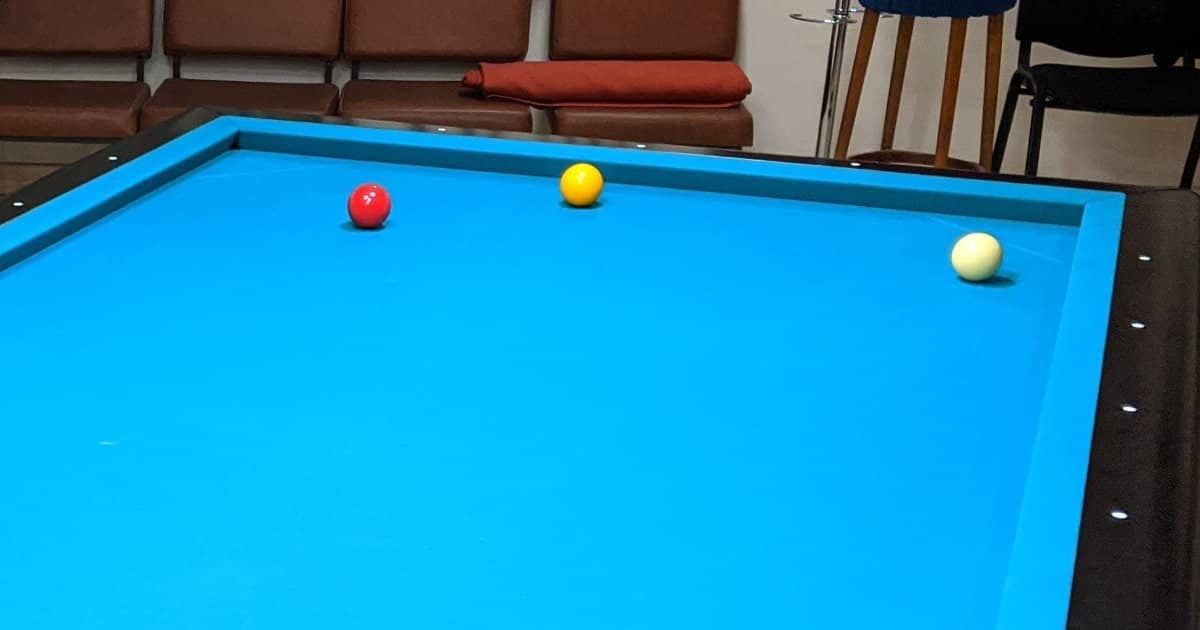
All carom games use the same table and the same three balls. What changes is what you must do to make a point valid.
| Game | A point counts when | Main restriction | Turns | Typical match |
|---|---|---|---|---|
| Three-cushion | Cue ball makes at least 3 cushion contacts before the second ball | The cushion rule | Shoot until you miss | 30 to 50 points at top level |
| One-cushion | Cue ball touches at least 1 cushion before the second ball | The cushion rule | Shoot until you miss | Medium distances |
| Straight rail (free game) | Your cue ball hits both other balls | Small barred zones in the corners (UMB) | Shoot until you miss | Long distances, often hundreds of points |
| Balkline (47/2, 71/2, 47/1) | Your cue ball hits both other balls | Only 1 or 2 points in a row inside a marked zone | Shoot until you miss | Long distances, set by the event |
| Five-pins | The opponent's ball knocks down pins or hits the red | You must hit the opponent's ball first | One shot each | Often 50 or 60 points |
| Artistic | You complete a set trick shot | Fixed program of figures | Up to 3 tries per figure | Total score over the program |
Rules common to all carom games
Table and balls
A match table is heated and has no pockets. Under the UMB World Rules of Carom Billiard the playing surface, measured between the cushion noses, is 2.84 × 1.42 m, with 5 mm tolerance either way. This is the size people call a 10 ft table. Smaller tables are common in clubs and bars. The cushions are low, about 37 mm high, and the rails carry diamonds every eighth of the length.
There are three balls of 61 to 61.5 mm. Each player has a cue ball, one white and one yellow (older sets use two whites, one marked with a dot). The red is the object ball for both players. You only ever strike your own cue ball.
Five small crosses on the cloth mark the spots where balls are placed at the start and after some fouls. The UMB names them the top spot, the centre spot, the bottom spot and two starting spots. In American rule books the top spot is the foot spot and the bottom spot is the head spot.
How a point is made
A point, also called a carom or cannon, is made when your cue ball touches both other balls in the same shot. It counts once all three balls have stopped and no foul was committed. Each valid carom is worth one point in every game except five-pins.
Lag, opening shot and innings
- The lag. To decide who starts, both players send their cue ball from the starting line to the far short cushion and back. The ball that stops closer to the near cushion wins the choice to start or let the opponent start.
- Starting position. The red goes on the top spot, the opponent's ball on the bottom spot, and the starter's cue ball on one of the two starting spots. The opening shot must hit the red ball first. Five-pins uses its own setup.
- Innings. Each visit to the table is an inning (a turn). You keep shooting while you score. A miss or a foul ends the inning.
- Equal innings. Many events give the second player a last inning if the starter reaches the target first, so both have played the same number of turns. If both reach the target, the match is a draw or goes to a tie-break.
- Average. Results are judged by the average, which is points divided by innings. Scoring 40 points in 32 innings gives an average of 1.25.
Fouls
In the carom games where you shoot until you miss, a foul costs you no points. It simply ends your inning and the opponent plays the balls where they lie, unless a ball has to be re-spotted. Common fouls are:
- A ball jumping off the table or touching the wooden frame.
- Shooting before all balls have stopped, or playing the opponent's cue ball.
- Touching a ball with your hand, clothes or cue, or hitting the cue ball twice (a push shot).
- Not having at least one foot on the floor as you shoot.
- Leaving a mark on the cloth or cushion to aim with.
If your cue ball stops touching another ball, you can ask for the balls to be re-spotted or play away from it without moving the touching ball. In the free game re-spotting is compulsory.
Three-cushion
Three-cushion is the main carom game in world competition, from the UMB World Cup and World Championship to professional tours such as the PBA in Korea. It is also the game you are most likely to see on a carom table in a club.
Setup and the opening shot
The red goes on the top spot and the opponent's ball on the bottom spot. The starter places their own cue ball on either starting spot, just to the left or right of the bottom spot. The opening shot must hit the red first, so the usual opening sends the cue ball off the red and around the table to come back to the opponent's ball.
Taking turns
You keep shooting as long as you score. Nothing is called in advance, so a lucky point counts the same as a planned one. Your inning ends when a shot fails to score or you commit a foul. The opponent then plays from where the balls stopped.
Scoring and winning
A point is valid when your cue ball hits both object balls and touches the cushions at least three times before it reaches the second ball. Players say a shot "made three rails".
- The three contacts do not have to be on three different cushions. Hitting the same cushion twice counts twice.
- Cushion contacts can happen before the first ball, between the two balls, or both. Only contacts before the second ball count.
- Kiss shots (the balls touching each other along the way) are allowed.
- A point made with fewer than three contacts is a foul ("no cushion", "one cushion" or "two cushions") and the inning ends.
Watch the average on the scoreboard. In three-cushion, about 1 point per inning is national level, and the best professionals average 1.5 or more over a tournament.
Common fouls
- Making the point with fewer than three cushion contacts before the second ball.
- Missing the red on the opening shot.
- A ball leaving the table. In three-cushion only the balls that left are re-spotted.
- Shooting into a cushion your cue ball is touching (you may play away from it).
- Any of the general fouls above, such as a push shot or playing the wrong ball.
League and house variations
| Format | How it is usually played |
|---|---|
| UMB World Cup | Qualifying games to 30 or 35 points, group games to 40, knockout games to 50. |
| Championships and leagues | Games to 40 or 50 points, usually with equal innings and a shot clock. Drawn knockout games go to a penalty shoot-out. |
| Set play | Some events and professional tours play several short sets instead of one long game. |
| Club and handicap | Each player gets a target based on their average, so a stronger player might need 30 while a beginner needs 12. |
Formats change often, so check the event's own regulations for distances, innings limits and shot clocks.
One-cushion
In one-cushion your cue ball must touch at least one cushion before it reaches the second object ball. The cushion can come before the first ball or between the first and second ball. Hitting both balls without a cushion is a foul called "no cushion", and your inning ends without a point.
The rule makes close-up scoring much harder than in straight rail (the free game, explained below), so there are no zones on the table. It is a good step up for players who want to learn the angles before trying three-cushion.
Straight rail (free game)
Straight rail is the simplest carom game. Any shot where your cue ball hits both other balls is a point, with or without cushions. It is the usual first game for beginners because almost any carom counts.
The difficulty at high level is that strong players learn to keep the three balls close together and score small, soft caroms again and again. To stop endless runs, the UMB free game bars small zones in each corner of the table, where only a limited number of points in a row is allowed. Events set the distance (the target score), and at high level these targets are long.
League and house variations
- In casual play there are usually no barred zones at all, and players agree a short target such as 25 or 50 points.
- Older American straight rail limited "crotching" (trapping the balls in a corner) to a few points before a ball had to be driven out.
Balkline
Balkline was created to stop the close-up runs of straight rail. Fine lines drawn on the cloth divide the table into zones. The game's name gives the rules. The first number is the distance of the lines from the cushions in centimetres. The second number is how many points you may score in a row while both object balls stay in the same zone.
Setup and zones
Taking turns and scoring
- 47/2 and 71/2. When both object balls are in the same zone, you may score one point there. With the next point at least one object ball must leave that zone, otherwise it is a foul and your inning ends.
- 47/1. The strictest version. Any point scored with both object balls in one zone must drive at least one of them out.
- Anchors. The small squares where a line meets the cushion count as zones of their own. They stop players from trapping the balls along the line against the cushion.
- A ball sitting exactly on a line counts as inside the zone, which works against the player.
The referee announces the position out loud ("in", "out", "anchor") so players and spectators can follow. Apart from the zone rule, play is the same as straight rail. Balkline is played mainly in Europe, especially in the Netherlands and Belgium.
Five-pins
Five-pins (cinque birilli) is the Italian carom game and is especially popular in Italy and parts of South America. Here you strike your cue ball into the opponent's cue ball and use that ball to knock down pins or hit the red.
Setup
Five small pins stand in the middle of the table. The red pin goes on the centre spot, and four white pins stand around it in a cross, two along the length and two across the width. Pins and balls go back on their marked positions before every shot.
Taking turns and scoring
Players take one shot each, whether they score or not. Every shot must hit the opponent's cue ball first. Cushions are not required. Points come from what the opponent's ball does next:
- Each white pin knocked down: 2 points.
- The red pin knocked down together with white pins: 4 points. The red pin alone is worth more (8 points, or 10 in some international formats).
- Making the opponent's ball hit the red ball: 3 points. Your own cue ball hitting the red after the opponent's ball: 4 points.
Common fouls
- Missing the opponent's ball, or hitting pins or the red with your cue ball before it.
- Knocking down pins with your own cue ball. The pin points go to the opponent.
- Sending a ball off the table.
After a foul the opponent receives points (often 2 plus the value of anything knocked down) and usually ball in hand, which means they can place their cue ball before shooting. Games are often played to 50 or 60 points, or in sets.
Artistic billiards
Artistic billiards is a test of control. Instead of playing an opponent shot by shot, each player attempts a fixed program of figures (set trick shots) with the balls placed exactly on marked positions. A figure is valid only when the cue ball makes the carom along the required path.
Each figure has a value based on its difficulty, and you usually get three attempts. The UMB program lists 76 figures worth 4 to 11 points each, for a possible total of 500. In a match players alternate figures and the higher total wins.
Official rules and governing bodies
The world body for carom is the UMB, and these are the rule texts this guide is based on.
Where to play carom near you
We have 81 venues with carom tables. Find one near you now.
Discover other billiard variants
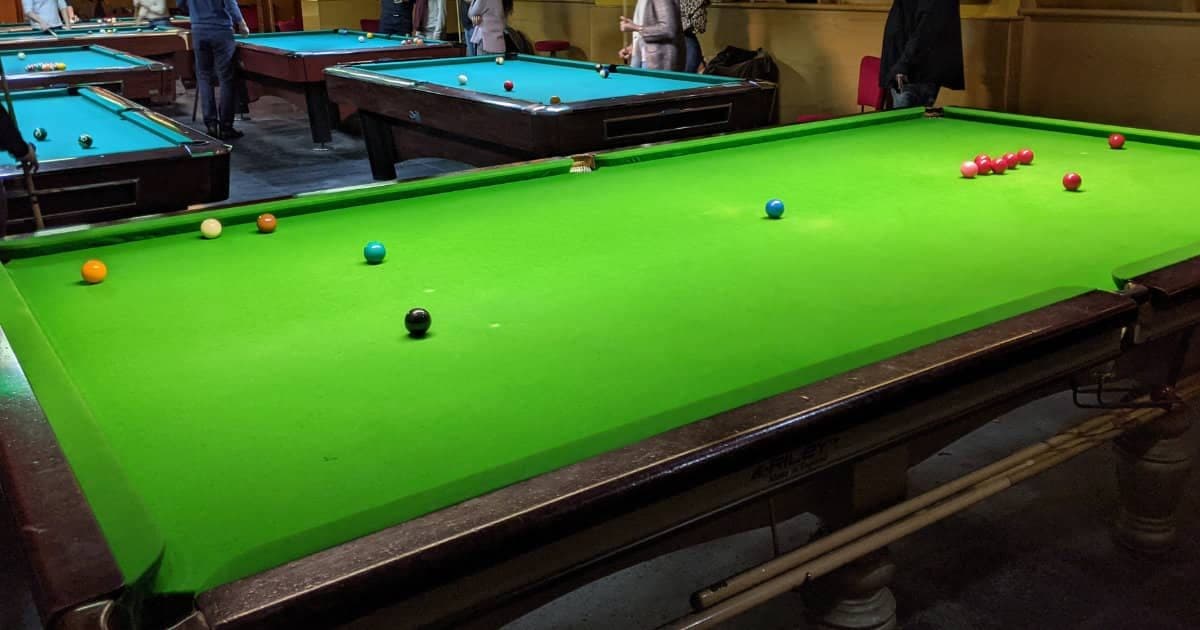 Snooker rulesReds, colours, breaks and the 147 maximum.
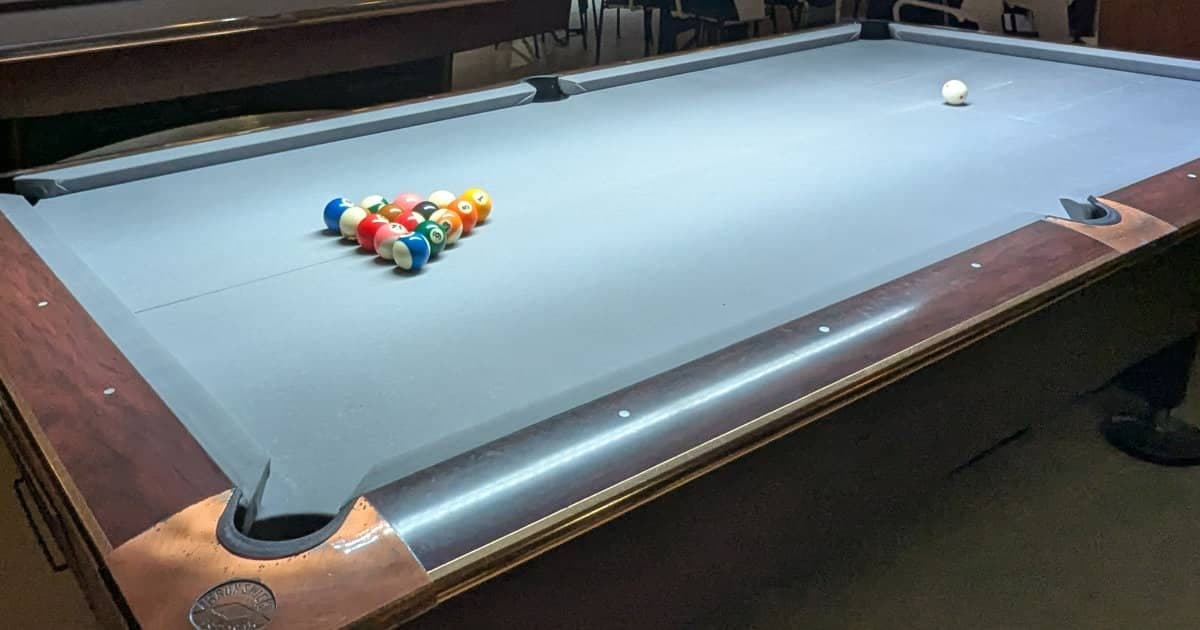 American pool rules8-ball, 9-ball, 10-ball and straight pool explained.
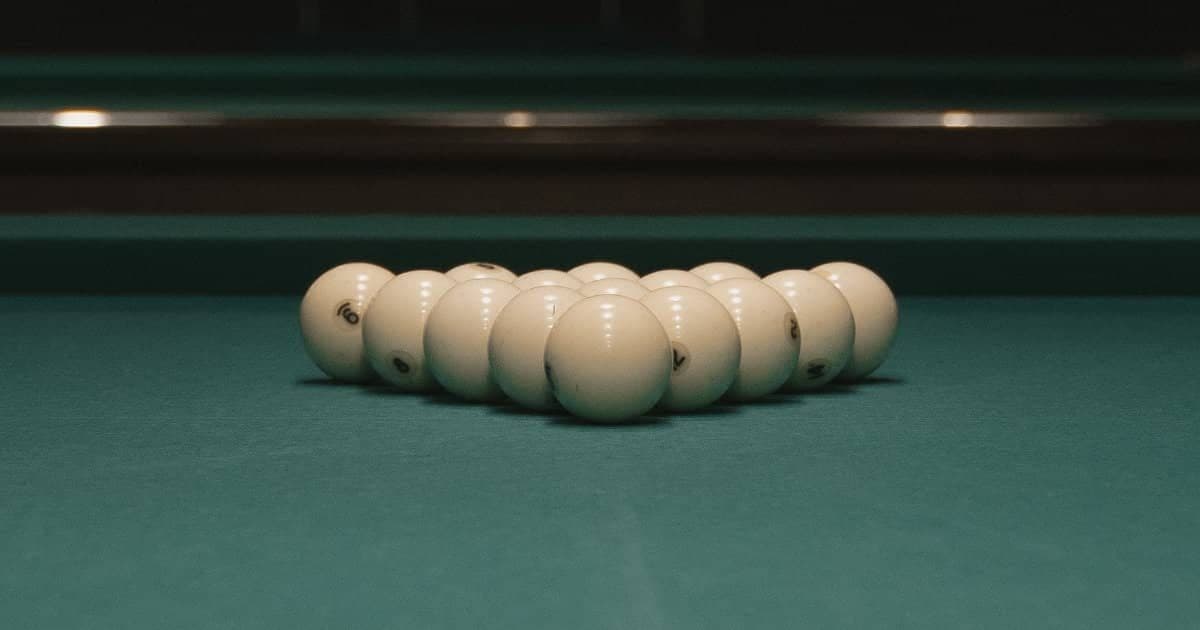 Russian pyramid rulesBig table, tight pockets, first to eight balls.
Frequently asked questions
Why do carom tables have no pockets?
Carom games score by contact between balls, not by potting, so pockets would only remove balls from play. The unbroken cushions also let the balls bounce cleanly around all four sides, which three-cushion depends on.
Why are carom tables heated?
A heater under the slate keeps the cloth dry, so the balls roll faster and more consistently. UMB rules require heated tables for official tournaments.
Can you play three-cushion on a pool table?
You can try for fun with three pool balls, but the pockets swallow balls and break up cushion shots, and pool cushions are higher than carom cushions. For real practice you need a carom table.
Is carom easier than pool?
Straight rail is easy to start with because almost any contact scores. Three-cushion is one of the hardest cue games to master, since you must plan the cue ball's path around the table on every shot.
What cue do you use for carom?
Carom cues are usually a little shorter than pool cues, with a thinner, stiffer shaft and a tip of about 11 to 12 mm. They suit the smaller, heavier carom balls, but any cue works for casual play.