
The games at a glance
Two games are played on a heyball table. Heyball is by far the most common. Golden Nine is a fast 9-ball game scored in points.
| Game | Balls | Objective | Call your shot? | How you win a rack | Typical match |
|---|---|---|---|---|---|
| Heyball | 15 object balls | Pot your 7 (solids or stripes), then the 8 | No, flukes count | Pot the 8 legally after your group | Race to a set number of racks, or a timed match |
| Golden Nine | 9 object balls | Hit the lowest ball first, pot the 9 | No, flukes count | Pot the 9 legally; 4, 7 or 10 points | Points over a set number of racks |
Rules common to both games
The table and balls
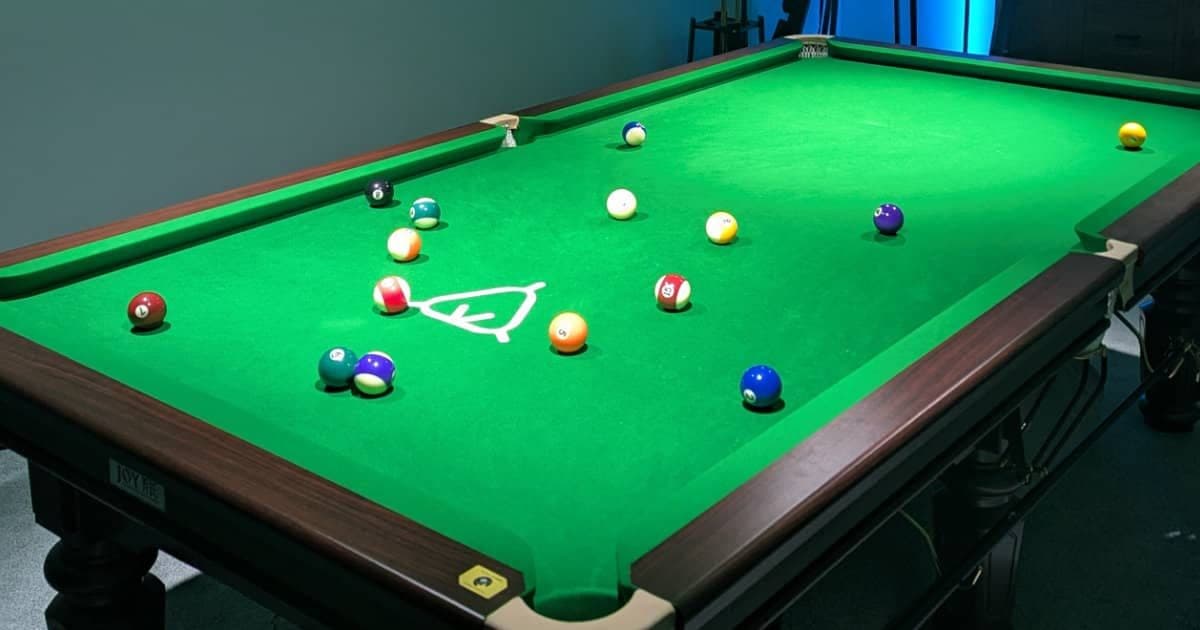
The playing surface measures 2,540 × 1,260 mm, about the same as a 9-ft American pool table. The difference is in the pockets and cushions. Heyball pockets are narrow and cut like snooker pockets, so a ball has to be struck cleanly to drop. The balls are the standard 57.15 mm pool size, the same as in American pool.
Two marks matter. The foot spot sits on the center line, 635 mm from the top cushion; the rack goes here. The head string is a line across the table 635 mm from the bottom cushion. The area between the head string and the bottom cushion is the break zone, often called the kitchen.
Lag and shot clock
A match starts with the lag. Both players hit a ball up to the top cushion at the same time, and the one that stops closer to the bottom cushion wins the choice of who breaks. Professional events use a shot clock of 45 seconds per shot. Each player gets one 30-second extension per rack, and running out of time is a foul.
Legal shots and ball in hand
On every shot the cue ball must hit a legal ball first. After that, you must pot a ball, or any ball (the cue ball included) must reach a cushion. Miss either requirement and it is a foul. You may jump the cue ball over other balls, as long as you strike it on its upper half.
After most fouls your opponent gets ball in hand: they place the cue ball anywhere on the table and shoot in any direction. The exception is a foul on the break, covered in each game below.
Common fouls in both games:
- Potting the cue ball, or knocking it off the table.
- Hitting the wrong ball first.
- Touching a ball with your hand, clothing or cue.
- A double hit or a push, where the tip stays on the cue ball too long or touches it twice.
- Shooting while a ball is still moving, or with both feet off the floor.
- Knocking an object ball off the table.
Object balls that leave the table are not put back (the 8 in heyball and the 9 in Golden Nine are the exceptions). A ball sitting on the edge of a pocket that drops within 3 seconds counts as potted.
Heyball (Chinese 8-ball)
Setup and rack
The referee racks the 15 balls in a tight triangle with the apex ball on the foot spot. The 8-ball goes in the center. Each back corner holds one solid and one stripe, and the rest are spread so that solids and stripes are kept apart as much as possible. Both players can inspect the rack and ask for corrections.
The break
The winner of the lag chooses who breaks, and then the players take turns breaking. Place the cue ball anywhere behind the head string. Letting more than half of the cue ball cross the line gets a reminder the first time and is a foul after that.
The break must be hit with real force. A deliberately soft break is penalized in steps: a warning, then the loss of a rack, then the loss of the match.
A break is legal if at least four object balls reach a cushion, or if at least one ball is potted.
After an illegal break there is no ball in hand. Your opponent either plays the table as it lies, or has the balls re-racked and chooses who breaks again.
If the breaker fouls (for example by potting the cue ball), the opponent picks one of three options: ball in hand behind the head string, re-rack and break, or re-rack and let the breaker break again.
If the 8 drops on a clean break, the breaker either has it put back on the foot spot and keeps shooting, or breaks again. The 8 on the break never wins the rack.
Taking turns
The table is always open after the break, even if balls went down. On an open table you can aim at any ball except the 8. Hitting the 8 first is a foul.
Your group is fixed by the first ball you pot legally after the break. Pot a solid and you have solids for the rest of the rack. If you pot one of each with the same legal shot, you choose. Once the table is closed, the cue ball must hit one of your own balls first. When your group is cleared, it must hit the 8 first.
You never call your shot in heyball, not even on the 8. If a ball drops by luck (a fluke), it counts and you keep shooting.
Watching a heyball match, expect lots of safety play. The tight pockets make long pots risky, and with ball in hand anywhere after a foul, leaving your opponent a clear table usually costs you the rack.
Scoring and winning
You win the rack by legally potting the 8 after your group is cleared. You lose the rack if you:
- pot the 8 on a shot where you foul;
- pot the 8 before your group is cleared, including on the same shot as your last group ball;
- knock the 8 off the table.
Most events are a race to a set number of racks. Some are timed (120 minutes is the WPA example). When time runs out, the player with more racks wins. If the score is tied, the match goes to a shootout: the cue ball sits on the head spot and the 8 on the foot spot, and each player gets five shots at it with a 30-second clock. Each successful shot scores a point, and a tie goes to sudden death.
Common fouls
- Hitting a ball from your opponent's group, or the 8 too early.
- No ball potted and no ball reaching a cushion after contact.
- Scratching (potting the cue ball), which gives your opponent ball in hand.
- Shooting from in front of the head string when you have ball in hand behind it.
- Letting your phone ring, which is a foul the first time and costs a rack after that.
- An intentional foul, which costs you the rack the first time and the match the second.
Heyball has no three-foul rule. However many fouls you commit, each one simply gives your opponent ball in hand.
How heyball differs from American 8-ball
| Heyball (WPA) | American 8-ball (WPA) | |
|---|---|---|
| Table height | Higher: 31.5 to 33.5 in (800–850 mm) to the cushion top | 29¼ to 31 in (743–787 mm) |
| Pockets | Tight, snooker-style, about 3.3 to 3.5 in (84–89 mm) | Wider, usually 4 to 5 in (102–127 mm), with straight-cut jaws |
| Cloth | Napped, snooker-style cloth (a wool blend). The nap changes how slow-rolling balls run, so it is brushed in one direction | Usually worsted cloth with no nap, smoother and faster |
| Calling | Never, flukes count | Call the ball and pocket unless obvious |
The 8 in the center of the rack, the four-balls-to-a-cushion break and ball in hand anywhere after a foul are the same in both games. What feels different is the pace. Heyball players spend more time on safeties and position because the pockets punish a slightly loose shot.
Golden Nine (Chinese 9-ball)
Golden Nine is a 9-ball game played on the heyball table. Instead of counting racks, each rack is worth points depending on how it was won. The details below follow the standard rules of the Duya Legends Tour.
Setup and rack
The nine balls form a diamond. The 1-ball sits at the front on the foot spot, the 9 in the middle and the 2 at the back. The other six go in any order, all touching.
The break
The winner of the lag breaks first, and after that the winner of each rack breaks. The cue ball goes anywhere behind the head string, and it must hit the 1-ball first. Hitting another ball first or potting the cue ball is a foul, and your opponent gets a point and ball in hand. A weak break that leaves fewer than four object balls touching a cushion is also a break foul. Your opponent then plays with ball in hand or asks for the break to be taken again.
A legal break also needs enough balls to cross the head string. The rule counts balls that end up on the breaker's side of the line, plus potted balls:
- four or more balls across (or at least half of the balls left);
- one ball potted and three across, two potted and two across, or three potted and one across;
- four or more balls potted.
A ball that crosses the head string and is then potted counts twice. If the break falls short, the incoming player either plays from there or has the balls re-racked and chooses who breaks.
Potting the 9 on a legal break with no foul is a golden break: you win the rack and it scores as a table run. If you foul while potting it, the 9 goes back on the foot spot and your opponent has ball in hand.
Taking turns
You must hit the lowest-numbered ball on the table first, as in standard 9-ball. Any ball can then go in, including the 9 off a combination. There is no calling of balls or pockets, so flukes count. The 9 is re-spotted if it leaves the table. The shot clock is 45 seconds, with one 30-second extension per rack.
Scoring and winning
The player who pots the 9 legally wins the rack and scores points according to how the rack went. Fouls also give points to the opponent.
- Break and run (10 points): you break legally and clear the table in the same visit.
- Table run (7 points): you pot a ball on the break and finish with a combination on the 9 in the same visit; or you come to the table with both the 1 and the 9 still on it and clear up without a combination on the 9; or you make a golden break.
- Normal win (4 points): any other way of potting the 9.
- Fouls: your first and second foul in a rack each give your opponent 1 point. A third foul in the same rack loses you the rack and gives your opponent 2 points.
Common fouls
- Not hitting the lowest-numbered ball first.
- Scratching, or knocking the cue ball off the table.
- Running out of time on the shot clock.
- Using a phone or headphones in the playing area, which costs the rack the first time and gets you disqualified the second.
- An intentional foul, which loses you the rack and gives your opponent 10 points. A second one loses the match.
League and house variations
Eight golden nine is the handicap built into the Duya rules. When a man aged 14 or over plays a woman or a boy under 14, the weaker player wins a rack by potting the 8 as well as the 9. For runs worth 7 or 10 points, they still have to finish on the 9. Players of the same level play the standard game.
The Chinese text of the rules adds a mercy rule: the match ends early when one player leads by more points than are left to play (remaining racks × 10). Organizers can also change the shot clock and break order for their event.
Official rules and governing bodies
For the full wording, including referee procedures and dress code, read the official rules.
Where to play heyball near you
We have 6 venues with heyball tables. Find one near you now.
Discover other billiard variants
 American pool rules8-ball, 9-ball, 10-ball and straight pool.
 Snooker rulesReds, colours and the break-off from the D.
 English pool rulesReds and yellows on a 7-ft table.
Frequently asked questions
Is heyball the same as Chinese 8-ball?
Yes. Heyball is the international name for Chinese 8-ball, the game played on Chinese tables with tight pockets. Golden Nine is the 9-ball game played on the same table.
Can I play heyball on an American pool table?
You can use the same rules, and the table is almost the same size. The game will feel much easier though, because American pockets are wider and accept shots that would rattle out on a heyball table.
Do heyball and American pool use the same balls?
They are the same size, 57.15 mm. From 25 August 2025 the WPA requires its UNITY ball set at heyball events.
Is there a three-foul rule in heyball?
No. In heyball each foul just gives your opponent ball in hand. Golden Nine is different: a third foul in the same rack loses the rack.
Why do heyball players wear waistcoats and bow ties?
The WPA heyball rules set a formal dress code by default, much like snooker: waistcoat, long-sleeved shirt, bow tie, black trousers and black leather shoes. Organizers can set their own.