
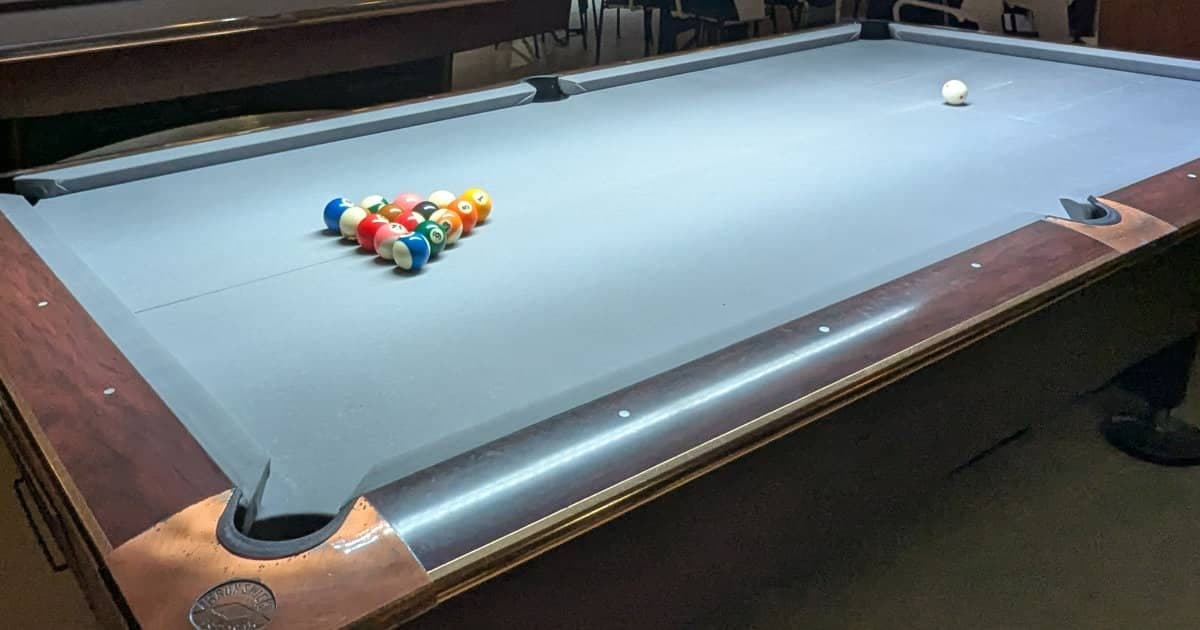
The five games at a glance
All five games are played on the same six-pocket table with the same numbered balls. What changes is which balls you may hit, whether you have to call your shots and how a rack is won.
| Game | Balls | Objective | Call your shot? | How you win | Typical match |
|---|---|---|---|---|---|
| 8-ball | 15 | Pot your group (solids or stripes), then the 8 | Yes (WPA); leagues vary | Pot the 8 legally after your group | Race to a set number of racks |
| 9-ball | 1 to 9 | Always hit the lowest ball first | No | Pot the 9 on any legal shot | Race to a set number of racks |
| 10-ball | 1 to 10 | Always hit the lowest ball first | Yes, every shot | Pot the 10 on a called shot as the last ball | Race to a set number of racks |
| Straight pool (14.1) | 15, re-racked as you go | Score one point per ball | Yes, every shot | Reach the target score first | One long game, often to 100 or 150 |
| One-pocket | 15 | Pot balls only in your own corner pocket | No | First to 8 balls in your pocket | Race to a set number of racks |
Rules common to all American pool games
The World Pool-Billiard Association (WPA) publishes the international Rules of Play, and every big league in North America builds on them. The basics below hold for all five games.
The table and its markings
Tournament tables are 9 feet long, with a playing surface of 100 × 50 inches. Bars usually have 7-foot tables and homes often have 8-foot ones. The proportions are always 2:1 and the rules are the same on every size.
- Head string: an imaginary line across the table a quarter of the way from the head rail (the end you break from). It passes through the second diamond.
- Kitchen: the area between the head rail and the head string. The WPA calls it "above the head string". The cue ball starts here for every break.
- Foot spot: the marked spot a quarter of the way from the foot rail, where the rack goes. Balls that are put back on the table ("spotted") go on or just behind it.
- Head spot and center spot: marks on the head string and in the exact middle of the table, used mainly in straight pool.
Lag, break and turns
At the start of a match both players lag: each shoots a ball to the far rail and back, and the one who stops closest to the head rail decides who breaks. You stay at the table as long as you pot a ball legally. When you miss or foul, your turn (your "inning") ends.
What makes a legal shot
On every shot the cue ball has to hit the right ball first. After that, either a ball goes into a pocket or at least one ball (the cue ball or any object ball) touches a rail. A shot that does neither is a foul called no rail after contact, which is how a "safe" tap against a ball is kept in check.
Common fouls
- Scratch: the cue ball goes into a pocket or off the table.
- Wrong ball first: the cue ball hits a ball you are not allowed to hit first.
- No rail after contact: nothing is pocketed and no ball reaches a rail.
- Touching a ball with your hand, clothing or cue, other than the normal tip-on-cue-ball stroke.
- Double hit or push shot: the tip stays on the cue ball or strikes it twice.
- No foot on the floor, shooting while balls are still moving, and knocking a ball off the table.
Ball in hand
In 8-ball, 9-ball and 10-ball the usual penalty for a foul is ball in hand: your opponent picks up the cue ball and places it anywhere on the table. After a foul on the break it is often limited to the kitchen. Straight pool and one-pocket work differently: the player who fouls loses a point and the cue ball normally stays where it stopped.
Jump and massé shots
A jump shot is legal when you strike down on the cue ball so it bounces off the cloth over a blocking ball. Deliberately digging under the cue ball to scoop it into the air is not allowed. Massé shots, where you strike down steeply to make the cue ball curve, are not banned by the WPA rules, but many venues forbid them to protect the cloth.
All-ball fouls or cue-ball fouls only
Under WPA rules, touching or moving any ball by accident is a foul. Most leagues are more forgiving: they play cue-ball fouls only, so brushing an object ball with your sleeve is not a foul as long as it does not touch the cue ball. The opponent simply puts it back (see the league boxes below).
Before your first rack in a new league or bar, ask three things: is it call-shot, what happens on an 8-ball break, and is it cue-ball fouls only?
8-ball
The most played pool game in the world. One player takes the solids (1 to 7), the other the stripes (9 to 15), and the black 8 is pocketed last to win.
Setup and rack
The 15 balls are racked tightly in a triangle with the apex ball on the foot spot. The 8 goes in the middle of the third row, and the two back corners hold one solid and one stripe. Everything else goes in any order.
The break
The breaker places the cue ball anywhere in the kitchen and does not have to call anything. A legal break either pots a ball or drives at least four object balls to a rail. If it does neither, the opponent chooses: play the table as it lies, re-rack and break, or make the breaker break again.
- 8-ball potted on a legal break: under WPA rules this is not a win. The breaker either has the 8 spotted and plays on, or breaks again.
- Scratch on the break: a foul. The opponent takes the cue ball in hand in the kitchen. If the 8 also went down, it is spotted (or the opponent can ask for a re-break).
Taking turns
After the break the table is open, whatever was potted. Groups are decided by the first ball someone pots legally on a called shot after the break: pot a stripe and you have the stripes. On an open table you may hit any ball first except the 8.
From then on you must hit one of your own balls first. Under WPA rules you call each shot by naming the ball and the pocket. Nobody expects you to announce an obvious one, and you never need to name rails or kisses. You may also call safety: your turn ends after the shot even if one of your balls goes in, and that ball stays down.
Scoring and winning
Once all seven of your balls are gone, the 8 is your ball. Pot it in the pocket you called and you win the rack. You lose the rack if you:
- pot the 8 before your group is cleared, including on the same shot as your last ball;
- pot the 8 in a pocket you did not call;
- foul while potting the 8, such as scratching;
- knock the 8 off the table.
None of these apply on the break.
Common fouls
- Hitting the other player's ball or the 8 first.
- Scratching or failing to hit a rail after contact.
- The penalty is ball in hand anywhere for your opponent. WPA 8-ball has no three-foul rule.
League and house variations
| Rule | WPA | APA | BCAPL (CSI) | VNEA |
|---|---|---|---|---|
| 8 on the break | Spot it and play on, or re-break | Wins (loses if you also scratch) | Spot it and play on, or re-rack | League chooses: win, or spot / re-rack |
| Calling shots | Ball and pocket on every shot | Only the 8: mark the pocket | Obvious shots need no call; banks, kicks and combos do | Obvious shots need no call; banks and combos do |
| Groups after the break | Table always open | Pot only one group on the break and it's yours | Table open | Table open |
| Touching an object ball | Foul | Not a foul unless it hits the cue ball | Cue-ball fouls only | Not a foul unless it hits the cue ball (and a few other cases) |
VNEA lets each league pick: Option 1 makes the 8 on the break a win, and Option 2 (used at the VNEA World Championships) has the breaker spot the 8 or re-rack. In VNEA play, three fouls in a row is not a loss. In the APA you mark the pocket for the 8 before you shoot it, and you never call any other shot.
Common bar rules
House rules change from bar to bar, so agree on them before the first break. The ones you will meet most often:
- Slop counts: any of your balls that drops counts, called or not.
- 8 on the break wins, and scratching on the 8 loses.
- Two shots (or "two visits") after a foul instead of ball in hand.
- Ball in hand only in the kitchen after a scratch, and you must shoot out of it.
- Call the 8 even when nothing else is called; some bars add "last pocket", where the 8 must go in the pocket your last ball went in.
9-ball
The fast, attacking game of the pro tour. You must always hit the lowest-numbered ball first, but anything that drops counts, and the 9 wins whenever it goes in on a legal shot.
Setup and rack
Balls 1 to 9 are racked in a diamond. The 1 sits at the front, facing the breaker, and the 9 sits in the center. Under WPA rules the 9 is the ball on the foot spot. The other seven balls go in any order.
The break
The cue ball starts in the kitchen and must hit the 1 first. If no ball goes in, at least four balls must reach a rail, or it is a foul and your opponent gets ball in hand. In WPA events a third test applies: if nothing is potted, at least three balls must also cross the head string (the "three-ball rule"). A 9 potted on a legal break wins the rack straight away.
The push-out
Right after a legal break, the next shooter may announce a push-out. For that one shot there is no need to hit the lowest ball or a rail, so you can roll the cue ball to a better spot. Your opponent then decides who shoots next. A 9 potted on a push-out is spotted.
Taking turns
You never call your shots. Hit the lowest ball on the table first and any ball that drops keeps you at the table. Combinations, kisses and lucky rolls all count. When you miss, your opponent plays the cue ball from where it stopped.
Scoring and winning
The player who pots the 9 on a legal shot wins the rack, whether it is the last ball or goes in early on a combination. If the 9 drops on a foul, it is spotted and your opponent gets ball in hand. Matches are a race to a set number of racks. The lag decides the first break, and after that the break order varies by event: some play winner breaks, others alternate the break.
Common fouls
- Hitting a higher ball before the lowest one.
- Scratching, or no ball reaching a rail after contact.
- Three fouls in a row in the same rack lose it. The referee warns you when you come to the table on two fouls.
League and house variations
- APA: handicapped play is scored in points, not racks. Balls 1 to 8 are worth one point each and the 9 is worth two, and each player's target depends on their skill level. There is no push-out (Masters divisions allow it). A 9 on the break wins unless you scratch.
- BCAPL (CSI): the 1 goes on the foot spot and the 9 in the center. A 9 on a legal break wins, push-outs are allowed and three fouls in a row lose the rack.
- VNEA: a 9 on the break wins. The three-foul rule is optional, so check your league's local rules.
- Bars: winner usually breaks, push-outs are rare and the three-ball rule is almost never used.
10-ball
10-ball is 9-ball made harder. There is one more ball and every shot must be called, so lucky rolls don't count.
Setup and rack
Balls 1 to 10 fill a four-row triangle. The 1 is at the apex on the foot spot and the 10 sits in the middle of the third row. The rest go in any order.
The break
The break works as in 9-ball, without the three-ball rule. Start in the kitchen, hit the 1 first, and either pot a ball or send at least four balls to a rail, or it is a foul. A 10 potted on the break does not win. It is spotted and play goes on. The push-out rule after the break is the same as in 9-ball.
Taking turns
You must hit the lowest ball first, and on every shot after the break you name the ball and the pocket unless it is obvious. There is no safety call in 10-ball. If you pot a ball but not the shot you called, and you did not foul, your opponent chooses who shoots next. Balls that went in stay down, apart from the 10.
Scoring and winning
You win only by potting the 10 on a called shot when it is the last ball on the table. If the 10 drops any earlier, on the break, on a combination or by accident, it comes back to the foot spot.
Common fouls
- Wrong ball first, scratch or no rail after contact: ball in hand anywhere for your opponent.
- Three fouls in a row in one rack lose it.
League and house variations
BCAPL (CSI) racks the 2 and 3 on the two back corners and also spots a 10 that goes in early. 10-ball is mostly a tournament game. Bar and league nights in North America rarely play it, so if you find it on a league schedule, read that league's call-shot rules.
Straight pool (14.1 continuous)
The classic American game, where the best players run 100 balls or more without missing. Any ball can be played at any time, every ball you pot is a point, and the rack is rebuilt as you go so a run can continue for ever.
Setup and rack
All 15 balls are racked in a triangle with the apex on the foot spot, in any order.
The break
The opening break is the one defensive shot in the game. The breaker must either pot a called ball or drive the cue ball and two object balls to a rail. Failing that is a breaking foul: minus two points, and the opponent can play on or make you break again. That is why most opening breaks just clip a corner ball and send the cue ball back up the table.
Taking turns
Every shot is called: name the ball and the pocket. Any extra ball that drops on the same shot also scores. You may call safety instead, but any ball potted on a safety is spotted.
The re-rack
When only one object ball (the 15th) is left, play pauses. The 14 potted balls are re-racked with the apex spot left empty. The shooter carries on from where the cue ball and the 15th ball lie. The skill is to pot that 15th ball and break open the new rack with the same shot. Special rules move the 15th ball or the cue ball if either is sitting inside the rack area.
Scoring and winning
Each legally pocketed ball is worth one point, and the first player to reach the agreed target wins. Events set the number; 100 and 150 points are common. Scores can go below zero, because fouls cost points.
Common fouls
- Any standard foul costs one point. The cue ball stays where it stopped, except after a scratch, when your opponent gets it in hand in the kitchen.
- Balls potted on a foul are spotted.
- Three fouls in a row: you lose the point for that foul plus another 15, all 15 balls are re-racked, and you must break under the opening-break rules.
One-pocket
A slow, tactical game often compared to chess. Each player owns one corner pocket at the foot of the table, and only balls in that pocket count.
Setup and pockets
The 15 balls are racked in a triangle with the apex on the foot spot, in any order. Before breaking, the breaker picks one of the two foot corner pockets and the opponent gets the other. Under WPA rules, if the breaker says nothing, they get the pocket on the opposite side from where they placed the cue ball.
The break
The cue ball starts in the kitchen. There is no special break requirement beyond a legal shot, so most players break softly to push a few balls toward their own pocket without leaving an easy shot.
Taking turns
You may hit any ball first and you don't call shots. Your turn continues only while you pot balls in your own pocket. A ball that goes into one of the other four pockets is spotted at the end of your turn. A ball you knock into your opponent's pocket counts for them.
Scoring and winning
The first player with eight balls in their own pocket wins the rack. If one shot pots both your eighth ball and your opponent's eighth ball, the shooter wins. Matches are a race to a set number of racks.
Common fouls
- A foul costs one point: one of your scored balls is spotted. If you have none yet, you "owe" a ball and pay it back from your next score.
- After a scratch, your opponent has the cue ball in hand in the kitchen. Otherwise it stays where it stopped.
- Three fouls in a row lose the rack.
Official rules and governing bodies
For the full wording, or to settle a dispute, go to the rulebook your event or league plays under.
Where to play American pool near you
We have 4,404 venues with American pool tables. Find one near you now.
Discover other billiard variants
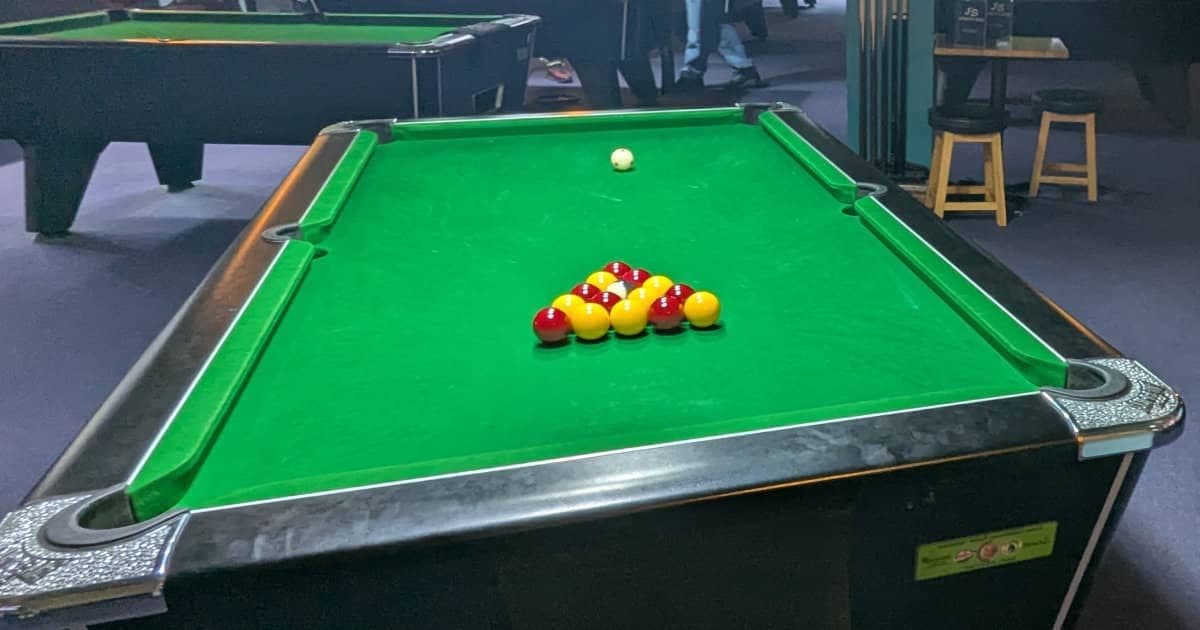 English pool rulesReds and yellows on a smaller table, with the black to finish.
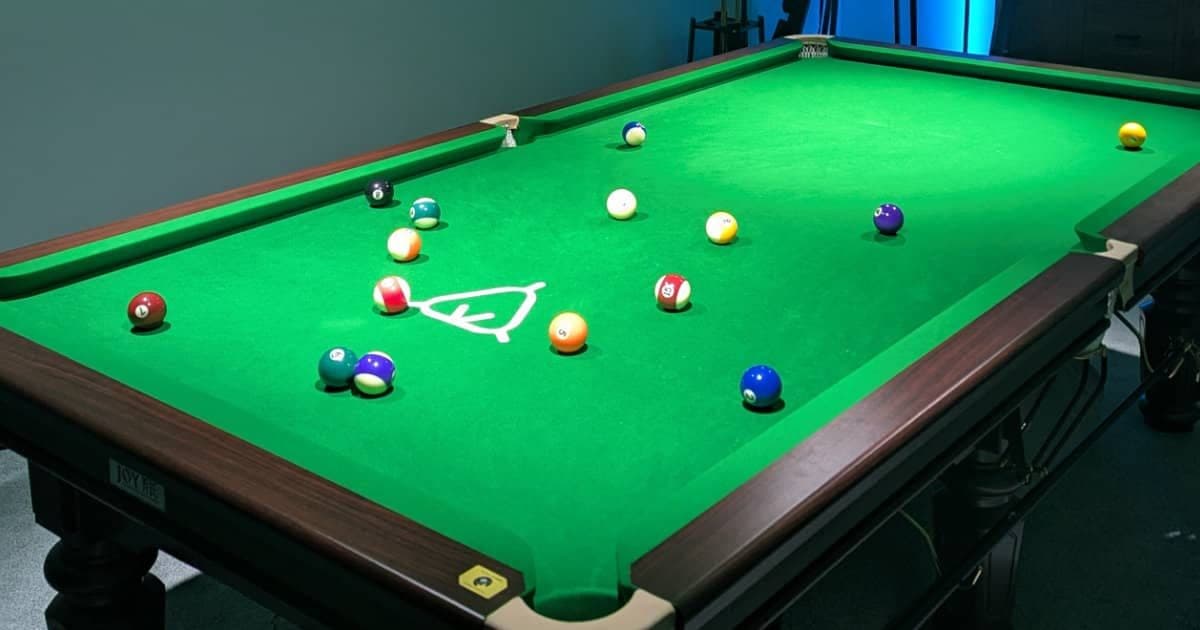 Heyball rulesChina's 8-ball game, played on a snooker-style table.
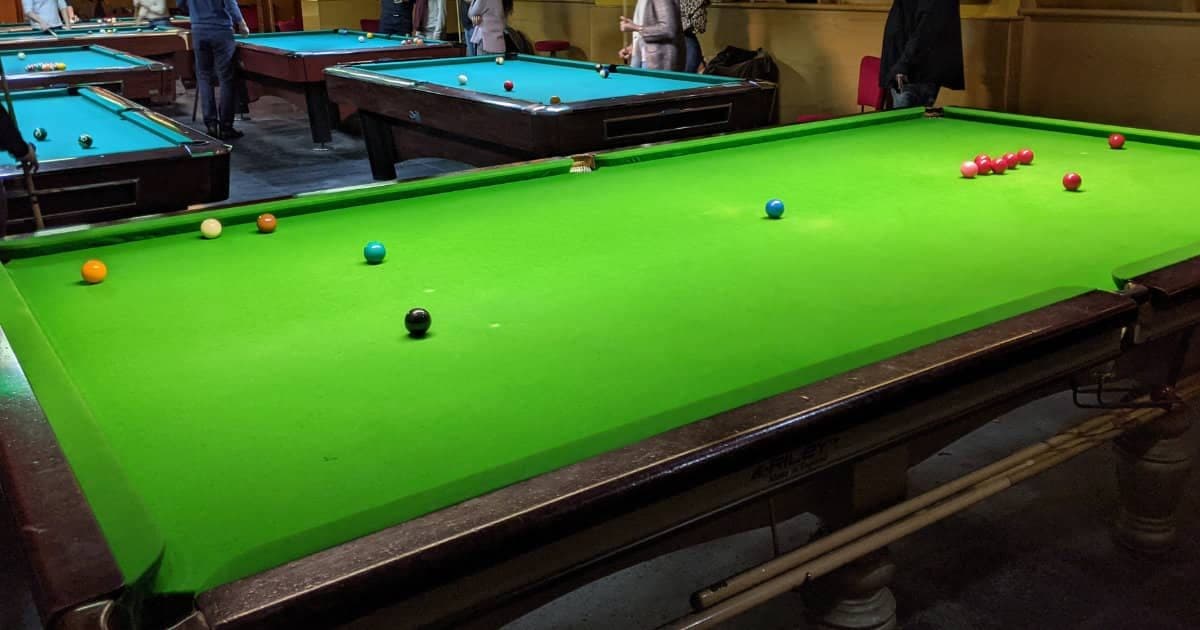 Snooker rulesReds, colours and breaks of up to 147 on a 12-foot table.
Frequently asked questions
What is the difference between pool and billiards?
Billiards is the umbrella term for all cue sports. In North America, "pool" means the games played on a six-pocket table, while carom billiards is played on a table with no pockets at all. See our carom rules for that family.
What does "race to 7" mean?
It is the match format. The first player to win seven racks wins the match, however many racks the opponent has. Short bar matches are often a race to 3 or 5, and pro 9-ball and 10-ball finals often go to 9 or more.
Who breaks after the first rack?
It depends on the event. Some play "winner breaks", where whoever won the last rack breaks the next one, and others alternate the break. VNEA league matches start with the home team breaking and then alternate.
Do you have to keep one foot on the floor when you shoot?
Under WPA rules, yes: shooting with no foot touching the floor is a foul. In the APA it is not a foul, but it can count as a sportsmanship violation when a bridge is available. If a shot is out of reach, use the bridge (the stick with a notched head) instead of climbing onto the table.
Can you play these games on a 7-foot bar table?
Yes. The rules are the same on any size table, and most league play in bars happens on 7-foot tables. The smaller table makes potting easier and the break more powerful, so expect more balls to drop on the break.