
Pyramid games at a glance
All four games use the same table, balls and rack. The big difference is which ball you are allowed to hit with your cue.
| Game | Ball you strike | After a svoyak | Call your shot? | How you win |
|---|---|---|---|---|
| Free pyramid (American) | Any ball on the table | Counts, play on from where the balls lie | No | First to 8 points |
| Dynamic pyramid (Nevsky, Siberian) | Colored ball only | Cue ball in hand anywhere on the table | No | First to 8 balls |
| Combined pyramid (Moscow) | Colored ball only | Cue ball in hand in home, play out of home | No | First to 8 balls |
| Classic pyramid | Colored ball only | See below | Yes, ball and pocket | First to 71 points |
A svoyak (Russian for "one's own") is a shot where the ball you strike with the cue hits another ball and then drops into a pocket itself. In pool you would call it a scratch. In pyramid it is a normal, scoring shot.
Rules common to all pyramid games
The table and the balls
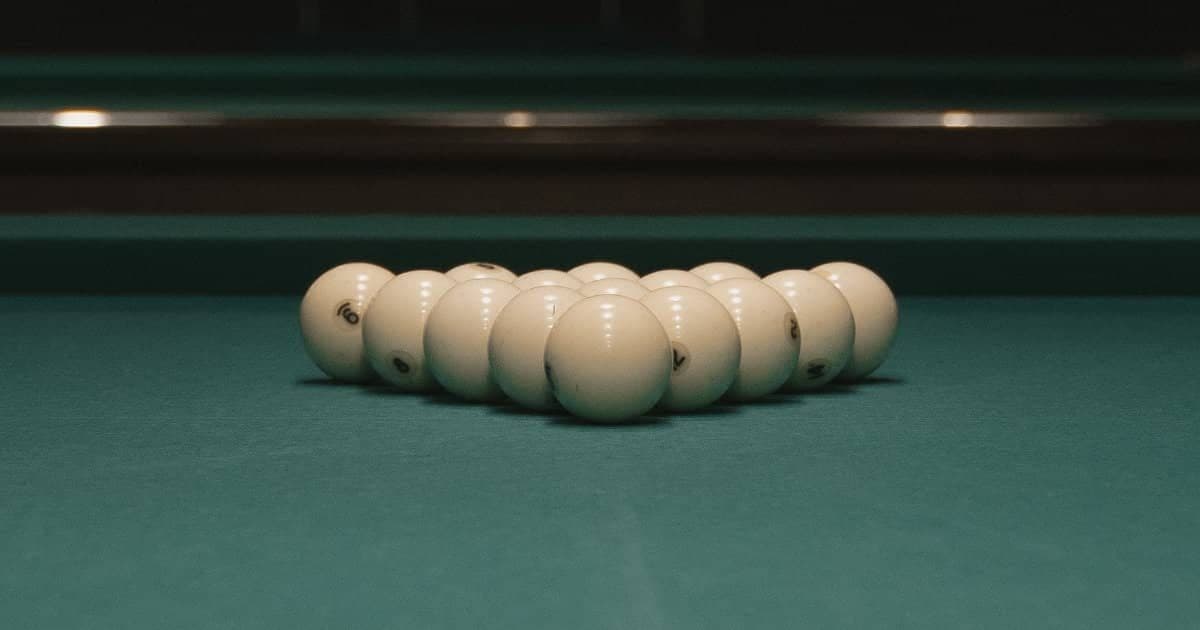
A tournament table is called 12 ft and has a playing area of about 3,550 × 1,775 mm, close to a snooker table. Clubs also have 10, 9 and 8 ft tables. The balls are much bigger than pool balls, about 68 mm across, and the set has 15 ivory-white balls numbered 1 to 15 plus one colored ball without a number, usually yellow or dark red.
The table has these marks:
- Center line across the middle of the table, with the center spot on it. It splits the table into the head half and the foot half.
- Head spot in the middle of the head half, with the home line drawn across the table through it.
- Home is the area between the home line and the head cushion. It is the pyramid version of the kitchen in pool. The line itself is not part of home, and a ball counts as being where its center is.
- Foot spot in the middle of the foot half, and the spotting line from the foot spot to the foot cushion.
Pockets barely wider than the ball
This is what makes pyramid feel so different from pool. A corner pocket is only about 4 to 5 mm wider than a ball, and a middle pocket about 14 to 15 mm wider. Balls that are a fraction off line rattle in the jaws and stay out, so players hit hard and need very precise aim.
The rack and the break
Every game starts with the 15 numbered balls in a tight triangle, the pyramid, with the apex ball on the foot spot and the back row parallel to the foot cushion. The colored ball is the cue ball for the break. You place it by hand anywhere in home, then break. Players take turns to break in each frame of a match.
If the break is not legal, it is a foul, and the incoming player chooses one of four options. Play on from the position, make the breaker play the next shot, have the balls re-racked and break, or have them re-racked and make the opponent break again.
Taking turns
You never call your shot in free, dynamic or combined pyramid, and any ball that drops on a legal shot counts for you. You keep shooting as long as you pocket a ball on each shot. If you pocket nothing, your turn ends. Your cue ball must hit an object ball on every shot, either directly or off a cushion.
A shot that pockets nothing must still send balls to the cushions or across the center line, otherwise it counts as a foul. This stops players from simply rolling the ball up and hiding it.
Fouls and penalties
The most common fouls are:
- missing all the object balls with the cue ball,
- a ball jumping off the table,
- touching a ball with your hand, clothing or anything other than the cue tip,
- a double hit or a push shot, where the tip stays on the cue ball as it reaches the object ball,
- playing without at least one foot on the floor,
- a shot that does not meet the conditions above, or an illegal break.
After a foul, any balls pocketed on that shot do not count and go back on the table, together with any jumped balls. Then a penalty ball comes off the table and goes onto the opponent's shelf, worth one point to them. The opponent then decides whether to shoot next or make you shoot again. Several fouls on one shot still cost only one penalty. A referee can also give a foul for slow play, with a limit of up to 45 seconds per shot.
Putting balls back on the table
Balls that go back on the table are placed on the foot spot. If there are several, they go on the spotting line from the foot spot toward the foot cushion, touching each other in any order. If other balls are in the way, they go as close as possible to the foot spot without touching them.
Free pyramid (American)
Free pyramid, known in Russian as Amerikanka ("the American"), is the most played version and the only game with its own page in the International Pyramid Confederation (IPC) rules. It is fast and attacking, because you can almost always find a ball to play with.
Setup and rack
Standard pyramid rack, apex on the foot spot, colored ball in home. See the diagrams above.
The break
The break is the only shot where you must use the colored ball as your cue ball. You play it with the ball in hand from home, and the break must meet one of the three conditions shown above.
Taking turns
From the second shot on, you choose before each shot which ball to strike with the cue. It can be any ball on the table, white or colored, including a ball that was just put back on the foot spot. Every other ball becomes an object ball for that shot.
You can pocket the object ball, pocket your struck ball off the object ball (a svoyak), or both. You do not call anything, and every ball that drops on a legal shot counts. You keep playing after each legal pot and the turn passes when you pocket nothing.
The ball you strike must hit another ball first. If it rolls straight into a pocket without touching anything, that is a foul.
Scoring and winning
Each ball you pocket legally scores one point and goes onto your shelf. Each foul by your opponent gives you one point too, as you take a ball of your choice from the table. The first player to 8 points wins the frame.
Common fouls
- Striking a ball that misses every other ball.
- A ball jumping off the table.
- Pocketing nothing without meeting the cushion conditions.
- Touching a ball by accident while you get into position.
League and house variations
Free pyramid with continuation. The Russian federation also plays a long version. The frame goes on past 8, and when 14 balls are down and two are left, the 14 are re-racked as a pyramid with its top ball missing and play carries on. Matches are played to a set total of points, for example 70.
Smaller tables. Bars often have 8 to 10 ft pyramid tables. The rules stay the same, but pockets on cheaper tables can be a little more generous.
Dynamic pyramid (Nevsky, Siberian)
Dynamic pyramid, also called Nevsky or Siberian pyramid, uses the colored ball as the only cue ball, like the combined game. What makes it "dynamic" is the reward for a svoyak.
Taking turns
You always strike the colored ball. You score by pocketing a white ball, or by pocketing the colored ball after it hits a white one. After a svoyak, you take a white ball of your choice from the table as your point, then place the colored ball anywhere on the table and play on.
On that next shot you may not pocket the colored ball again. A second svoyak in a row counts as a foul.
Scoring and winning
Each pocketed white ball or svoyak is worth one ball on your shelf. The first player to collect 8 wins. Frames are usually shorter than in combined pyramid, because a good svoyak lets you set up the perfect next shot.
Combined pyramid (Moscow)
Combined pyramid, long known as Moscow pyramid, is the classic club game in Russia. It is slower and more tactical than free pyramid, because you only ever hit the colored ball.
Taking turns
You always strike the colored ball, and it may only go into a pocket after touching a white ball. After a svoyak, you take a white ball of your choice from the table, then play your next shot with the colored ball in hand from home. On that next shot, balls only count in the two middle pockets and the two corner pockets at the far end.
From home you may only play at a ball that lies outside home. If every white ball is inside home, you play from the opposite end of the table instead, which acts as a temporary home.
Scoring and winning
Every pocketed white ball and every svoyak counts as one ball. The first player to 8 wins the frame.
Common fouls
- Pocketing the colored ball without it touching a white ball.
- From home, hitting a ball that is inside home.
- Any of the general fouls, such as a jumped ball or missing every ball.
League and house variations
Russian sources disagree on whether "Moscow" and "combined" are exactly the same game. In one common house version of Moscow pyramid, your opponent chooses which ball you take after a svoyak, and a foul puts one of your own pocketed balls back on the table. Agree the house rules before you start.
Classic pyramid
Classic pyramid is the oldest form and works more like a points game. It is rarely played at major tournaments today.
Scoring and winning
Before each shot you name the ball and the pocket. Each ball you pocket scores its number, except the 1 ball, which is worth 11. Whoever pockets the last ball on the table gets 10 extra points. That makes 130 points in total, so the first player to 71 wins.
Official rules and governing bodies
International pyramid is governed by the International Pyramid Confederation, whose rules are hosted by the Eastern European Billiard Council.
Where to play Russian pyramid near you
We have 3 venues with Russian pyramid tables. Find one near you now.
Discover other billiard variants
 Snooker rulesThe other 12 ft game, with reds, colours and the D.
 American pool rules8-ball, 9-ball, 10-ball and straight pool.
 Carom rulesThree balls, no pockets, from straight rail to three-cushion.
Frequently asked questions
Is Russian pyramid harder than pool?
Most players find it much harder to pot balls, because the table is bigger, the balls are heavier and the pockets leave almost no margin. Pool players usually need a few sessions just to get used to how hard you have to hit.
Can you play Russian pyramid on a pool or snooker table?
Not properly. Pyramid balls are about 68 mm, much bigger than snooker (52.5 mm) or pool (57 mm) balls, and pyramid pockets are cut tight to match. You need a real pyramid table, which is why we list them separately.
Where is Russian pyramid played?
It is the main billiard game in Russia, Ukraine, Belarus, Kazakhstan and much of the former Soviet Union. Outside that region you mostly find pyramid tables in clubs run by or for those communities, plus a few specialist billiard halls.
Do you need a special cue for pyramid?
Pyramid cues are usually heavier than pool cues and have a thicker tip, to suit the bigger and heavier balls. Clubs with pyramid tables keep house cues for them, so you do not need your own to start.
Why are the balls in Russian pyramid all white?
In the main games any ball scores the same, so there is no need for colors or groups. The numbers only matter in classic pyramid, where each ball is worth its number in points.