
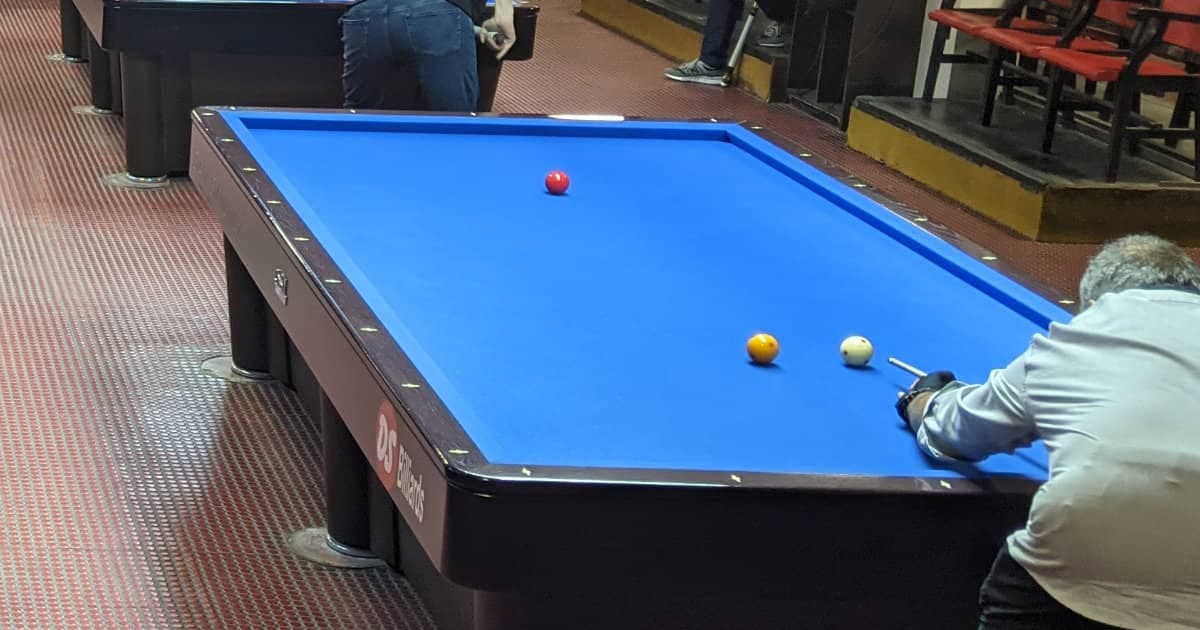
Carom billiards at a glance
| Table sizes | 7, 8, 9, 10 ft (10 ft for competition) |
| Playing surface (match table) | 2.84 × 1.42 m |
| Pockets | None |
| Balls | 3 balls: 1 white cue ball, 1 yellow cue ball, 1 red ball |
| Ball size | 61.5 mm |
| Main disciplines | Straight rail (free game), balkline, cushion carom, three-cushion, artistic billiards, five-pins |
| World governing body | Union Mondiale de Billard (UMB) |
How the game works
Each player has their own cue ball. You score a point (a carom) when your cue ball hits both the other balls in the same shot. Score and you keep playing; miss and it's your opponent's turn. Matches are played to a set number of points.
The different disciplines change what counts as a carom:
- Straight rail (free game): the basic game. Any shot that hits both balls scores.
- Balkline: the table is divided into zones by chalk lines, and you can only score a limited number of points while the balls are in the same zone. This stops players from "nursing" the balls in a corner.
- Three-cushion: your cue ball must touch at least three cushions before it hits the second object ball. The most popular discipline today.
- Five-pins (pins): an Italian variant with five small wooden pins in the centre of the table. Score by knocking pins down with your opponent's ball.
The table
A carom table has no pockets, which makes the cushions all the more important. Match tables are 10 feet long with a playing surface of about 2.84 × 1.42 m, a thick slate bed, fast cloth with no nap, and often heating under the slate to keep the cloth dry and the balls rolling true.
Smaller 7, 8 and 9 ft tables are common in bars and clubs, especially in Asia and Southern Europe.
Need to know if one fits your room? A 10 ft match table needs about 6.4 × 5.0 m (21 × 16½ ft). Compare all sizes in our table sizes & room size guide.
Equipment
- Cue: usually shorter and heavier than a pool cue, about 140 cm (55 in), with a thicker shaft and an 11.5–12.5 mm tip.
- Balls: 61.5 mm, larger than pool balls. Two cue balls (white and yellow) and a red.
- No rack needed: balls are placed on spots for each break.
Where carom billiards is played
Carom has deep roots in France, Belgium, the Netherlands and Spain, and is a major sport in Turkey, Egypt and Greece. In Asia, it's hugely popular in South Korea, Vietnam and Japan, where it's often played as four-ball. Latin America has a strong scene too, especially in Colombia, Peru, Ecuador and Mexico.
The professional scene
The UMB organises the Three-Cushion World Championship and the World Cup series. In South Korea, professional leagues have turned three-cushion into a TV sport with big prize money.
Clubs and leagues
Carom is mostly played in dedicated clubs, many of which run their own leagues and handicap tournaments.
Famous players and events
Belgium's Raymond Ceulemans won dozens of world titles and is considered one of the greatest players of all time. Modern stars include Frédéric Caudron, Dick Jaspers, Torbjörn Blomdahl and a growing list of Korean and Vietnamese champions.
A short history
Billiards started in Europe as a lawn game, moved indoors onto tables, and by the 18th century was played with three balls on pocketless tables in France. Balkline was the great professional game of the late 1800s and early 1900s, before three-cushion took over as the main competitive discipline.
Where to play carom billiards near you
We have 83 venues with carom tables. Find one near you now.
Discover other table types
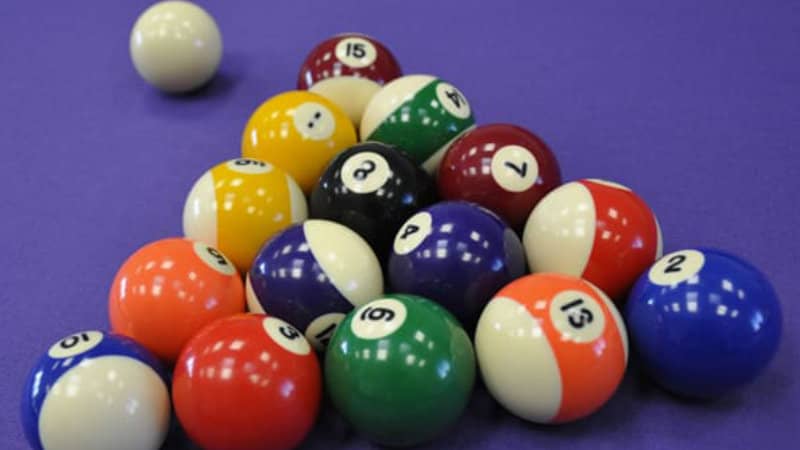 American poolthe pocketed game most people know.
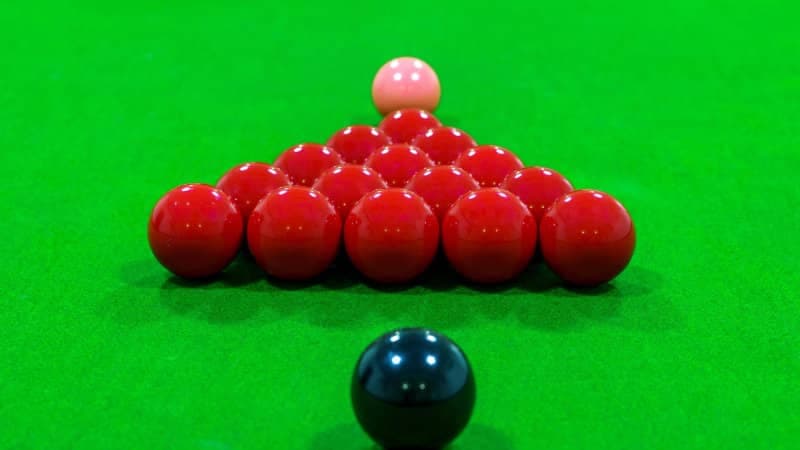 Snookeranother big-table precision game.
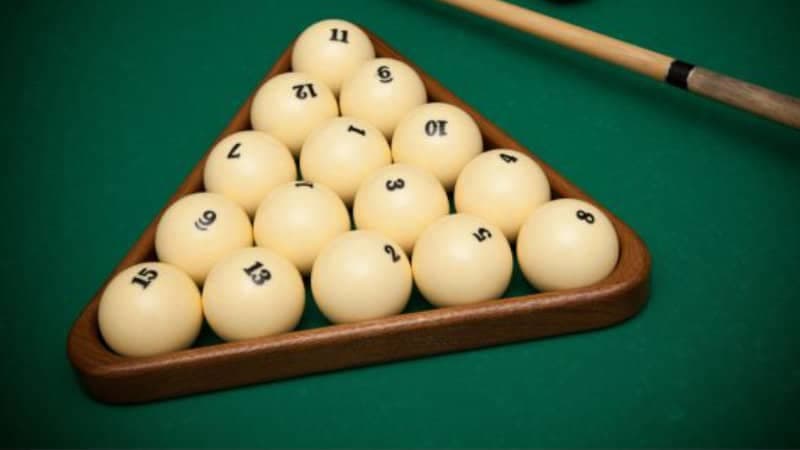 Russian pyramidbig balls and very tight pockets.
Frequently asked questions
Why does a carom table have no pockets?
Because the game isn't about potting balls. You score by making your cue ball hit the other two balls, so pockets would only get in the way.
What is three-cushion billiards?
The most popular carom discipline: your cue ball must touch at least three cushions before it hits the second object ball.
What size is a carom table?
Carom tables come in 7, 8, 9 and 10 ft sizes. The 10 ft match table has a playing surface of 2.84 × 1.42 m.
Can I play carom on a pool table?
Not really. Carom balls are bigger, the cloth and cushions are different, and the pockets would interfere with the game.