
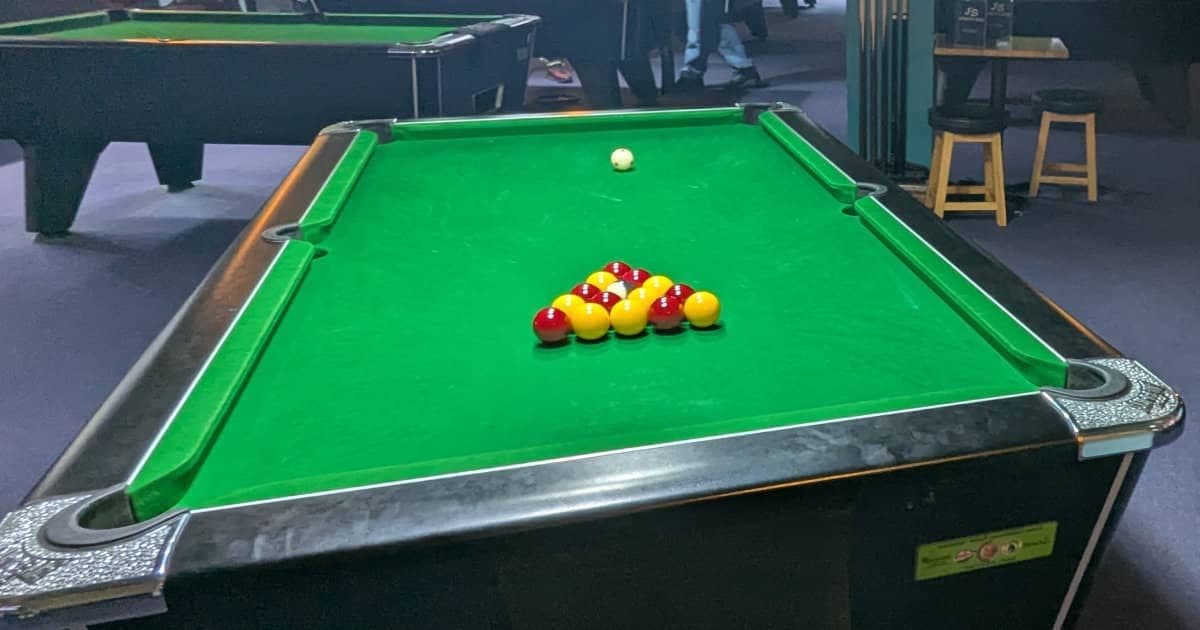
English pool games at a glance
Every version uses the same balls and the same goal. You pot your seven balls, then the black. What changes is how a break counts, what a foul gives your opponent, and how strict the referee is about tactical play.
| Rule set | Where you see it | Legal break | After a foul | Calling | Black on the break |
|---|---|---|---|---|---|
| International Rules | EPA national events, IEPF, Ultimate Pool | 3 points (pots + balls past centre) | 1 visit, cue ball anywhere | Only your group on an unclear open table | Re-spotted, play on |
| Blackball | WPA and EBA events, Ireland, many leagues | Pot a ball or 2 balls past centre | Free shot + 1 visit (often called two visits), from baulk or where it lies | No | Re-rack, same player breaks |
| World Rules | Older leagues (WEPF/EPA until 2022) | Pot a ball or 4 balls to a cushion | 2 visits, cue ball stays put | Choose colours aloud after the break | Re-rack, same player breaks |
| Pub rules | Casual games, house leagues | Varies | Usually 2 shots from baulk | Often the black pocket | Varies, often a win or re-rack |
Rules common to all English pool games
Table and balls
English pool is played on a 6 ft or 7 ft table. League and tournament play uses the 7 ft size. The pockets are rounded like snooker pockets and only just wider than a ball, so a pot has to be accurate. You play with seven reds, seven yellows, one black and a white cue ball. The object balls have no numbers. On most pub tables the cue ball is slightly smaller than the others (for example 1 7/8 in against 2 in), which lets a coin-operated table return it to you after a foul.
The markings matter more than they look:
- Baulk is the area at the end where you break, between the baulk cushion and the baulk line (International Rules call it the break line). The line sits one fifth of the table length from the baulk cushion. There is no D in English pool.
- The eight-ball spot (or black spot) is where the black is racked. It lies where the diagonals joining each middle pocket to the far corner pockets cross.
- The centre line is an imaginary line between the two middle pockets. Several rule sets use it to judge the break.
The goal
After the break the table is open, which means nobody owns a colour yet. The first player to pot a ball legally takes that colour as their group, and the opponent gets the other. Your balls are now the balls on. You keep playing as long as you pot one of your own balls on each shot. When your seven are gone you play the black, and potting it legally wins the frame.
A legal shot
All three official rule books ask for the same thing on a normal shot. The cue ball must first hit a ball you are on. After that, either a ball goes in, or the cue ball or any object ball touches a cushion. Simply rolling up to a ball and stopping is a foul.
Fouls everyone agrees on
- Potting the cue ball, called an in-off.
- Hitting the wrong colour first, or missing everything.
- No ball potted and no ball reaching a cushion after contact.
- Knocking a ball off the table.
- Playing with both feet off the floor, or touching a ball with your hand, clothes or cue.
- Jump shots and push shots (the tip stays on the cue ball or hits it twice). World Rules are a little softer on push shots.
How you lose a frame
The black is the danger ball in every version. You lose the frame on the spot if you pot the black before your group is cleared, or if you pot it on a shot that is also a foul (for example the black goes in and the cue ball follows it). Under International and World Rules you also lose if your last ball and the black drop on the same shot.
Before a casual game, agree three things out loud: what a foul gives, whether two shots carry onto the black, and whether you must call the black pocket. Most pub arguments start with one of these.
International Rules
International Rules began life as the "Supreme Rules" of the Ultimate Pool tour and were designed to be simple and quick. The English Pool Association (EPA) has used them for its national events since 1 January 2023, and they are the rules of the IEPF world championships and every Ultimate Pool event. If you watch English pool on a stream today, this is almost always what you are watching.
Setup and rack
The black goes on the eight-ball spot, in the middle of the third row. The head ball at the apex points toward baulk and sits on a marker on the rack line, a short line drawn through the spot along the length of the table. The rules only fix the black on its spot and ask for all the balls to be touching. The reds and yellows are normally set in the usual pattern shown below. Players toss a coin or lag for the first break: both hit a ball to the top cushion at the same time, and the one that comes back closest to the baulk cushion wins the choice. After that, players take turns to break.
The break
You can place the cue ball anywhere in baulk, as long as no more than half of it is over the break line. A break is legal when it scores at least 3 points. Each ball potted is worth 1 point, and each object ball that ends up wholly on the baulk side of the centre line is worth 1 point. A ball only counts once.
- Break fails to reach 3 points. The balls are re-racked and your opponent chooses who breaks.
- Cue ball goes in-off on a legal break. Your opponent gets one visit with the cue ball in hand from baulk.
- Black goes in on the break. It is re-spotted. If it was the only ball potted, your opponent comes to the table. If other balls dropped too, you carry on.
- Balls potted on the break do not give you a colour. The table stays open.
Taking turns
A visit is your turn at the table, and it lasts until you fail to pot one of your balls or commit a foul. On an open table, the first ball you pot legally decides your group. If one of each colour drops on the same shot, you get the colour the cue ball hit first. When it is not obvious which colour you are going for, the referee asks you to name your group before the shot.
You never call pockets, and combination shots do not need to be announced. You can even pot an opponent's ball, as long as you hit your own first, but it does not keep you at the table. Only potting one of your own does.
Fouls and ball in hand
After a standard foul your opponent gets one visit with ball in hand. They can play the cue ball from where it lies or pick it up and place it anywhere on the table. There are no two-shot penalties and no free shot. Common standard fouls are:
- An in-off, or hitting the wrong colour first.
- No ball potted and no ball to a cushion.
- A jump shot, push shot or double hit.
- Shooting before all the balls have stopped, or out of turn.
- Not playing away from a ball the cue ball is touching (the shot must go at 90 degrees or more away from it).
- Being coached during a frame after a warning.
Scoring and winning
You win the frame by potting the black on a legal shot once all seven of your balls are down. You lose it straight away if you:
- Pot the black on a foul shot, or while any of your balls are still on the table (including with your last ball on the same shot).
- Foul on purpose, or make no real attempt to hit one of your own balls.
- Behave in an unsporting way, for example arguing repeatedly or putting off your opponent.
If neither player can make a legal shot, the referee can call a stalemate. The frame is re-racked and the original breaker breaks again.
League and house variations
Ultimate Pool televised events add two extras on top of International Rules.
- Golden Break. Pot the black off the break and you win the frame there and then. Pot the black and foul on the same break (a Golden Duck, for example the cue ball also goes in) and you lose it.
- 6-Reds Shootout. A tied match is decided by both players potting six reds against the clock. The fastest time wins.
Leagues affiliated to the EPA can still choose their own rules, so a local league may be on International, World or Blackball rules.
Blackball
Blackball is the English pool ruleset recognized by the World Pool-Billiard Association (WPA). It is run in the UK by the English Blackball Association (EBA) and is widely played in Ireland, across Europe and in many local leagues. It looks like International Rules at first glance, but a foul works very differently.
Setup and rack
The rack is the same as in the diagram above, with the black on the black spot. Players lag for the first break, and the lag winner decides who breaks.
The break
You break from anywhere in baulk. The break is legal if you pot a ball, or if at least two object balls go fully past the centre line.
- Illegal break. Your opponent gets the standard foul penalty and may also ask for a re-rack.
- Black goes in on the break. The balls are re-racked and the same player breaks again, with no penalty.
- The table is always open after the break, whatever went in.
Taking turns
The first player to pot balls of only one colour on a normal shot takes that group. Groups are never decided on the break, on a foul or on a free shot. You do not call pockets. Potting an opponent's ball without potting one of your own is a foul.
If you are snookered, meaning you cannot hit any part of one of your balls with a straight shot, you only need to make contact with one of your balls. No pot or cushion is needed after it. Ask the referee to confirm the snooker first.
Fouls and the free shot
After a standard foul your opponent gets a free shot, then carries on with a normal visit, which is why people often call it "two visits". On the free shot they can play the cue ball from where it lies or take it in hand and place it anywhere in baulk. The table counts as open for that one shot, so they can hit or pot any ball, including the opponent's, without a foul. They can even play the black first, though potting it only wins if it was their ball on.
- An in-off, or the cue ball or any ball leaving the table.
- Hitting an opponent's ball first, or potting only an opponent's ball.
- No ball potted and no ball to a cushion after contact.
- A jump shot or push shot, or playing while balls are still moving.
- Touching a ball with your clothes, hair, chalk or rest.
- Playing too slowly after the referee has warned you.
Scoring and winning
Pot your group, then pot the black legally. If the black goes in on a combination with other balls, you win only if none of your own balls are left. You lose the frame if you pot the black on a foul or before your group is cleared, foul deliberately, or make no genuine attempt to hit a ball you are on. A stalemate leads to a restart with the original breaker.
World Rules
World Rules were written by the World Eightball Pool Federation (WEPF) in 1998 and used by the EPA until 2022. Many county and local leagues still play them, so you will meet them in plenty of pubs and clubs. The game is more tactical, because a foul does not let your opponent move the cue ball.
The break
The black is racked on the spot and you break from baulk. A fair break means you pot at least one ball or drive at least four object balls to a cushion. If you fail, your opponent gets two visits, the balls are re-racked and your opponent breaks. If the black goes in on the break, the balls are re-racked and the same player breaks again.
Taking turns
If you pot balls on the break, you tell the referee which colour you choose before your next shot. If you pick a colour you did not pot, you must pot one of it with your next shot. As with the other rules, a normal shot must hit one of your balls first and then pot a ball or send a ball to a cushion. When you are totally snookered, contact with one of your balls is enough. Potting an opponent's ball is a foul.
Fouls and two visits
A standard foul gives your opponent two visits. They miss once and still come back for a second turn. The cue ball normally stays exactly where it stopped. It only comes into baulk after an in-off. If your foul leaves your opponent snookered (a foul snooker), they can take the cue ball into baulk, or nominate any ball, the black included, as their ball for the first shot. That nominated ball is called a free ball, and potting the black this way loses the frame.
Because a foul costs you two visits but not the position of the cue ball, players sometimes foul on purpose to leave the cue ball tucked up safe. World Rules treat this as a normal foul, while International and Blackball rules make it a loss of frame.
Scoring and winning
Clear your colour and pot the black. You lose if you pot the black on a foul, while your balls remain, or with your last ball on the same shot. A frame where both players repeatedly fail to reach a ball can be declared a stalemate and replayed.
Pub rules
Most casual English pool still follows a loose version of the old EPA pub rules sheet. Nothing is written down in one place, so each venue has its own habits. The core is the same as everywhere else. After a foul, your opponent usually gets two shots and can place the cue ball anywhere in baulk.
League and house variations
These are common house rules, not official ones. Ask before the first break.
- Two shots carry onto the black. Some pubs let you keep your second shot when you are on the black. Others say you only ever get one shot at the black.
- First shot free. In many places the first of your two shots can hit any ball, much like a Blackball free shot.
- Call the black. You often have to name the pocket for the black. Some venues ban doubling the black off a cushion.
- Black on the break. Some pubs count it as a win, others re-rack.
- In-off on the black. Going in-off while playing the black usually loses the frame.
Official rules and governing bodies
These are the official rule books. Each covers every situation in far more detail than this guide.
Where to play English pool near you
We have 2 venues with English pool tables. Find one near you now.
Discover other billiard variants
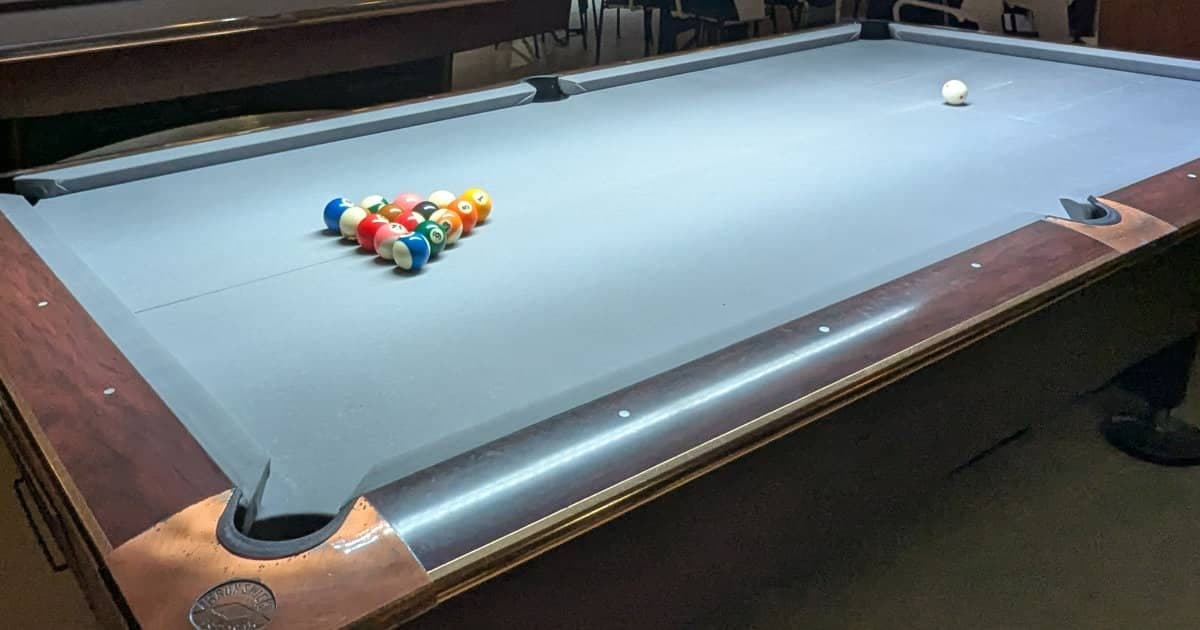 American pool rules8-ball, 9-ball and more on bigger tables with numbered balls.
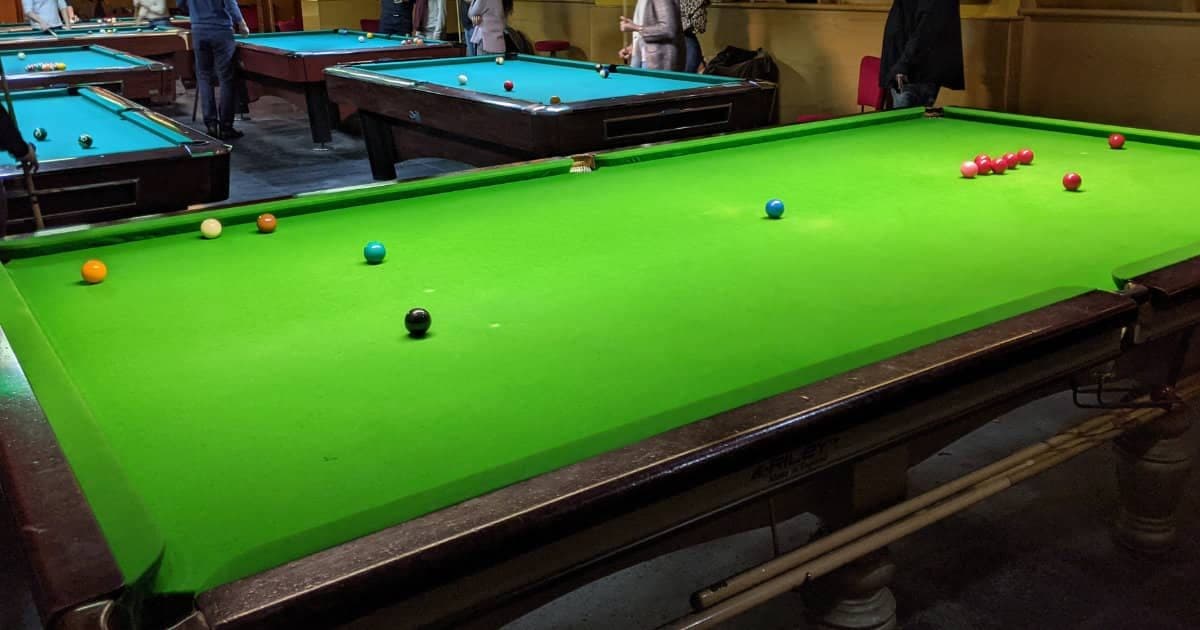 Snooker rulesReds, colours and break-building on a 12 ft table.
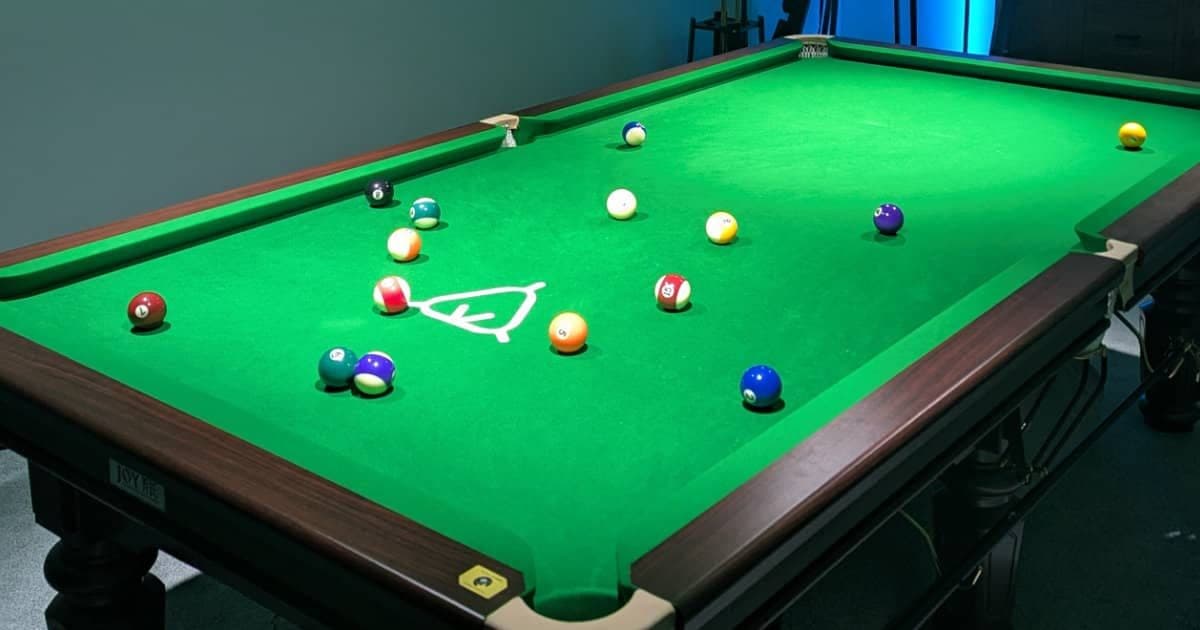 Heyball rulesChina's mix of English pockets and American balls.
Frequently asked questions
Is English pool the same as 8-ball pool?
It is a version of eight-ball. You still clear a group of seven balls and then pot the black, but the balls are unnumbered reds and yellows, the table is smaller and the pockets are much tighter. In the US you will often hear it called English 8-ball or blackball.
Why is the cue ball smaller on pub tables?
Coin-operated pub tables keep potted object balls locked away and return the cue ball to you. A slightly smaller cue ball lets the table sort it from the rest. Common sets pair 2 in object balls with a 1 7/8 in cue ball.
What is the difference between English pool and snooker?
Snooker uses a 12 ft table, 15 reds and six colours, and you win a frame by scoring more points. English pool uses a 6 or 7 ft table, two groups of seven and a black, and you win by clearing your group and then potting the black.
What does it mean to be snookered in pool?
You are snookered when no part of any ball you are allowed to hit can be reached with a straight shot, so you have to swerve or bounce the cue ball off a cushion. Blackball and World Rules relax the legal shot rule here, so touching one of your balls is enough.
Can you play English pool rules on an American pool table?
Yes, with solids and stripes standing in for reds and yellows. The rules work fine, but the game feels easier because American pockets are much wider and the balls are bigger.